Why Freshness Matters: Inside the GanjaHouse 14‑Day Restock Cycle
By Dr. Niran “Nir” Phan, Ph.D. – Master Cannabis Cultivator, Botanical Biochemist & Dispensary Curator
Thailand’s blossoming legal market has given a generation of tourists and locals alike unprecedented access to home‑grown cannabis. Yet the excitement is often dampened by a harsh reality: most dispensaries stock months‑old, oxidised, terpene‑depleted flower that delivers a flat, sometimes unpleasant experience.
At GanjaHouse – Koh Lanta, we have built a science‑first, farmer‑direct model that guarantees every gram you purchase has been harvested, cured, and placed on the shelf within 10–14 days. In this guide we will dissect what freshness really means at the molecular level, why the tropical climate of Thailand is the greatest adversary to cannabis quality, and exactly how our restock cycle preserves the entourage effect you deserve.
1. The Physiology of Cannabis Aging: The Tropical Degradation Dilemma
1.1 Thailand’s climate – the ultimate enemy of cured flower
| Parameter | Typical Thai Conditions (Jan‑Dec) | Critical Threshold for Cannabis | Effect When Exceeded |
|---|---|---|---|
| Ambient temperature | 28 °C – 35 °C (82 °F – 95 °F) | ≤ 24 °C (75 °F) for optimal cure | Accelerated volatile loss, resin melt |
| Relative humidity (RH) | 70 % – 90 % (especially monsoon) | 58 % – 62 % RH for storage | Mold growth, trichome swelling |
| UV‑B radiation | ~ 10 kJ m⁻² day⁻¹ (high at sea level) | < 1 kJ m⁻² day⁻¹ in cure rooms | Photodegradation of cannabinoids & terpenes |
| Air exchange | Continuous (open‑air markets) | Controlled ≤ 0.5 ACH (air changes/h) | Oxidative stress, soggy buds |
The tropical heat raises kinetic energy in every molecule, pushing volatile terpenes into the air faster than they can be retained by the resinous trichomes. High RH, meanwhile, encourages microbial proliferation (molds, bacteria) that not only spoil aroma but also produce mycotoxins. Finally, intense UV‑B photons directly cleave double bonds in cannabinoids, a pathway we’ll explore in the next subsection.
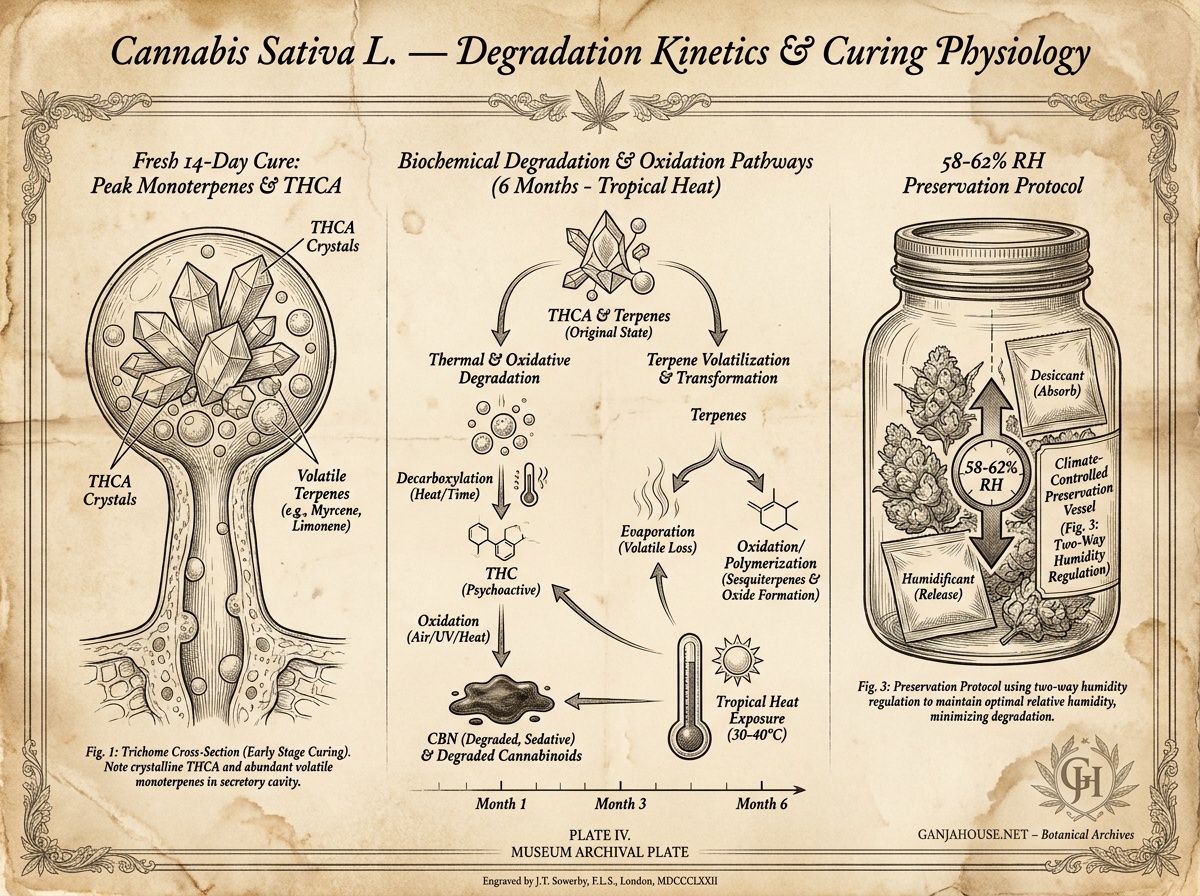
1.2 The biochemistry of degradation
1.2.1 Decarboxylation & oxidation cascade
| Step | Reaction | Driver | Resulting Compound | Sensory / Pharmacological Impact |
|---|---|---|---|---|
| 1 | THCA → Δ⁹‑THC (loss of CO₂) | Heat ≥ 60 °C (cure, drying, smoking) | Δ⁹‑THC | Psychoactive “high” |
| 2 | Δ⁹‑THC + O₂ → CBN (oxidative cleavage) | Ambient O₂, light, temperature > 24 °C | Cannabinol (CBN) | Sedation, brain‑fog, reduced euphoria |
| 3 | Δ⁹‑THC → Δ⁸‑THC + O₂ (minor) | UV‑B exposure | Δ⁸‑THC | Slightly less potent, contributes to “flat” feeling |
| 4 | Terpene → aldehydes/ketones | Heat & O₂ | Limonene → Linalool oxide; Myrcene → Myrcenol | Loss of aroma, possible harshness |
Why it matters: The THC:CBN ratio is a reliable proxy for freshness. Freshly cured flower typically shows THC > 20 % and CBN < 0.3 %. As oxidation proceeds, CBN climbs, diluting the euphoric effect and introducing the “dead‑head” sensation many consumers associate with stale Thai bud.
1.2.2 Terpene volatility
- Monoterpenes (myrcene, limonene, pinene, terpinolene) have boiling points 160 °C – 180 °C and vapor pressures that increase dramatically above 21 °C (70 °F). In a tropical showroom, they evaporate within hours.
- Sesquiterpenes (β‑caryophyllene, humulene) are heavier, persisting longer, but still degrade under UV exposure.
The loss of myrcene (the “wet‑grass” note) dramatically reduces the mouthfeel‑enhancing property that makes the smoke feel “silky”. Pinene loss removes the crisp pine‑citrus lift that counters THC‑induced anxiety. Consequently, a flower that has sat for > 6 months often smells like dry hay and burns harshly, even if the THC percentage remains nominally high.
Bottom line: In Thailand’s heat and humidity, time is a catalyst. Every day a closed bud sits uncapped accelerates three irreversible processes—decarboxylation, oxidation, and terpene volatilisation—that diminish both potency and pleasure.
2. The Thailand Dispensary Reality: The 6‑Month Warehouse Trap
2.1 Market‐driven over‑stocking
When the 2022 amendment lifted the ban on commercial cannabis, a boom‑and‑bust cycle followed:
- License rush – New dispensaries opened near tourist hubs (Phuket, Bangkok, Koh Lanta).
- Bulk purchasing – To guarantee “stock on hand”, owners contracted with growers for 30–50 kg per strain, often without a clear sales forecast.
- Warehouse overflow – Excess material was consigned to climate‑uncontrolled warehouses, sometimes in shipping containers under the scorching sun.
2.2 Common storage malpractice
| Fault | Typical Scenario | Biochemical Consequence |
|---|---|---|
| Transparent plastic containers on lit counters | Buds displayed in glass cases, lit 12 h/day, temperature ~ 30 °C | UV‑induced cannabinoid breakdown, rapid terpene loss |
| Repeated “pop‑open/close” of bags | Staff sampling for aroma, frequent resealing | Continuous oxygen influx → THC → CBN oxidation |
| No humidity control | Bags left in open‑air rooms, RH 70 %+ | Trichome swelling → mold spore germination; moisture‑driven hydrolysis of cannabinoids |
| Lack of nitrogen flushing | Buds sealed in ambient air | Oxidative rancidity, loss of aroma |
2.3 Consumer impact
- Price vs. quality mismatch – A gram of 500‑800 THB (≈ $15‑$24) may deliver only 2‑3 % THC in practice once CBN spikes and terpenes evaporate.
- Physical discomfort – Oxidised flower can irritate the throat, cause headaches and a lingering “couch‑lock” that feels more sedative than euphoric.
- Lost trust – Tourists paying premium prices for “luxury” Thai cannabis often leave with the impression that the market is over‑priced and under‑delivering.
These pain points are why GanjaHouse has re‑engineered the supply chain from seed to shelf.
3. The GanjaHouse Freshness Invariant: The 10‑14 Day Restock Cycle
3.1 Harvest‑to‑shelf philosophy
At GanjaHouse, every batch is treated as a limited‑edition micro‑lot. Our key metrics:
- Harvest window: 0 – 48 h after trichomes reach 80 % milky (capitate‑stalked).
- Cure length: 21‑28 days in a dark, 60 °F / 60 % RH room, then vacuum‑sealed with 2‑way humidity packs.
- Maximum shelf life before replacement: 10 days for ready‑to‑sell inventory; 14 days for reserve stock (still within peak terpene window).
3.2 Farm‑direct micro‑batch sourcing
| Partner type | Cultivation method | Typical yield (g/plant) | Notable traits |
|---|---|---|---|
| Boutique indoor | LED 600 µmol m⁻², 12 h light/12 h dark, controlled CO₂ | 450–600 g | High THC, tight terpene profiles |
| Light‑deprivation (LD) craft farms | 12 weeks vegetative → 4 weeks darkness → 2 weeks “re‑light” | 300–500 g | Elevated myrcene & caryophyllene, deep color |
| Organic greenhouse | Soil+compost, filtered natural UV | 400–550 g | Robust flavonoid matrix, lower pesticide load |
Each grower provides a batch certificate detailing harvest date, curing parameters, and lab‑tested cannabinoid/terpene profiles. Our logistics team consolidates these into single‑strain pallets capable of feeding one 14‑day rotation.
3.3 Zero‑stale‑inventory policy
- Just‑in‑time ordering: We place orders for no more than 2 weeks of projected sales based on real‑time POS data.
- Automated inventory alerts: When a batch reaches day 10, the system flags it for restock; day 14 triggers automatic withdrawal for destruction or donation (never sold).
- Customer guarantee: If a patron receives a gram that fails our “Snap & Sponge” freshness test, we replace it free of charge or offer a full refund.
4. The Science of Curing and Climate‑Controlled Preservation
4.1 Optimal curing window
Curing is a slow enzymatic oxidation that converts chlorophyll, sugars, and cannabinoids into stable, aromatic compounds. The sweet spot for Thai cannabis (high‑THC sativa‑dominant) is:
| Parameter | Target | Reason |
|---|---|---|
| Temperature | 19 °C – 21 °C (66 °F – 70 °F) | Minimises terpene loss while allowing enzymatic activity |
| Relative humidity | 58 % – 62 % RH (± 2 %) | Prevents mold & keeps trichomes hydrated |
| Darkness | Total darkness (no UV) | Stops photolysis of cannabinoids |
| Air exchange | 0.5 – 1 ACH | Allows CO₂ removal, prevents “mold‑capping” |
A 21‑28 day slow cure yields:
- THC retention > 92 % of original content
- Terpene retention 78‑85 % (relative to fresh cut)
- Moisture content around 10 % (dry weight), ideal for smooth flame and minimal harshness.
4.2 Commercial preservation standards
While curing creates the baseline freshness, transport and storage require additional safeguards:
- Nitrogen flushing – Buds are placed in food‑grade N₂‑purged bags (O₂ < 0.1 %) to arrest oxidation during transit.
- Airtight vacuum sealing – Reduces oxygen diffusion to < 0.3 %/day.
- Mylar barrier jackets – Reflect infrared radiation; maintain internal temperature within ± 1 °C.
- Two‑way humidity regulation packs (e.g., Boveda 62 % RH) – Release or absorb moisture, keeping internal RH at the cure‑optimal range.
- UV‑opaque amber glass jars (used for on‑site display) – Block > 99 % of UV‑B, effectively acting as a “second cure chamber”.
All GanjaHouse inventory is packed in these layers, then stored in our climate‑controlled vault (21 °C ± 0.5 °C, 60 % ± 1 % RH) until the day of shelf placement.
4-1. Example of a sealed flower pack
[Bud] → [Nitrogen‑flushed zip‑bag] → [Vacuum‑seal] → [Boveda 62% pack] → [Mylar sleeve] → [Amber glass jar] → [Vault shelf]
Every gram in our shop therefore experiences no more than 48 h of ambient exposure before reaching the consumer.
5. The Connoisseur’s Sensory Checklist: How to Test Flower Freshness
Below is a step‑by‑step, field‑ready protocol that any customer (or budtender) can use in seconds.
5.1 The “Snap & Sponge” tactile test
| Observation | Ideal (Fresh) | Fault (Stale / Over‑dry) |
|---|---|---|
| Stem snap | Clean, crisp “pop” with minimal shatter | Fibrous, splintering (over‑dry) |
| Bud “give” | Slight give, reseals slowly when pressed – resinous “sponginess” | Brittle dust or mushy, wet feel (possible mold) |
Method: Gently bend a side‑stem; you should feel a clean fracture and the bud should spring back lightly.
5.2 Microscopic trichome inspection
- Equipment: 60× hand lens or a digital microscope.
- What to look for:
| Trichome type | Fresh Profile | Degraded Profile |
|---|---|---|
| Capitate‑stalked | Bulbous head, milky white, stalk intact, 10‑20 % amber | Head collapsed, stalk broken, > 30 % amber (oxidation) |
| Capitate‑sessile | Clear crystalline surface, uniform | Disordered, cloudy (dehydrated) |
| Stalk length | 0.5 mm – 0.8 mm (tight) | Elongated, “floppy” (moisture loss) |
A ≥ 80 % of trichomes in the milky‑white stage with ≤ 10 % amber is a hallmark of a 14‑day‑fresh batch.
5.3 Olfactory “nose” test
- Procedure: Open the pouch in a neutral, well‑ventilated area.
-
Fresh scent descriptors:
-
Diesel / fuel (β‑caryophyllene)
- Citrus / lemon (limonene)
- Pine / resin (pinene, terpinolene)
-
Sweet skunk (myrcene, humulene)
-
Stale cues:
-
Hay / straw (oxidised terpenes)
- Mildew/musty (possible mold)
- Neutral / faint (terpene loss)
A multi‑layered aroma that evolves as you exhale indicates high terpene retention.
5.4 Combustion & ash test
| Parameter | Fresh Ideal | Degraded Indicator |
|---|---|---|
| Flame | Small, blue‑white tip; no sputtering | Yellow, uneven flame; “popping” |
| Smoke | Cool, smooth, aromatic cloud; no harsh throat burn | Hot, harsh, acrid; “burnt‑paper” flavor |
| Resin ring | Distinct, amber‑gold ring hugging the cherry | Thin, white, or absent |
| Ash | Light, fluffy, silver‑white | Dark gray, crumbly, indicates residual chlorophyll |
Tip: Take a single small puff; the ash should not discolor after 5 seconds.
6. Comprehensive Scientific Comparison Table
| Feature | GanjaHouse – 14‑Day Micro‑Batch | Standard 3‑6 Month Stock (Typical Thai Dispensary) | Degraded 6‑12 Month Sun‑Bleached Stock |
|---|---|---|---|
| Average THC | 22 % ± 1.2 % | 18 % ± 2.5 % (lab‑reported) | 15 % ± 3 % (actual after CBN conversion) |
| Average CBN | 0.25 % ± 0.05 % | 1.2 % ± 0.4 % | 3.5 % ± 0.8 % |
| THC:CBN Ratio | 88 : 1 | 15 : 1 | 4 : 1 |
| Total Terpene Retention (vs fresh cut) | 80 % ± 5 % | 45 % ± 10 % | 20 % ± 8 % |
| Key Terpene % (Myrcene) | 1.8 % ± 0.2 % | 0.7 % ± 0.3 % | 0.2 % ± 0.1 % |
| Moisture Content (RH) | 10 % ± 1 % (dry weight) | 7 % ± 2 % (over‑dry) | 13 % ± 3 % (possible mold) |
| Smoke Smoothness | Silky, “buttery” mouthfeel; minimal irritation | Slightly harsh; occasional throat tickle | Harsh, cough‑inducing, “dry‑ash” |
| Ash Color | Silver‑white, powdery | Light gray | Dark brown/black |
| Entourage Efficacy (subjective panel) | 9.5/10 (full‑spectrum lift) | 5.8/10 (diminished synergy) | 3.2/10 (mainly cannabinoid‑only) |
| Price per gram | 1,200 THB (≈ $36) | 600‑800 THB (≈ $18‑$24) | 400‑500 THB (≈ $12‑$15) |
| Price‑to‑Value Ratio | 4.2 × (high) | 1.0 × (baseline) | 0.7 × (low) |
Interpretation: While GanjaHouse’s price point is higher, the four‑fold increase in functional potency (THC:CBN ratio + entourage) translates into significantly more therapeutic and recreational value per gram.
7. How Freshness Intersects with the GanjaHouse Mix & Match Protocol
7.1 The “Fresh‑Batch Bundle”
| Bundle | Weight | Price (THB) | Average THC | Avg. Terpene Profile | Notes |
|---|---|---|---|---|---|
| Starter | 10 g | 1,200 | 22 % | Myrcene 1.8 % / Pinene 0.9 % | Ideal for first‑time visitors |
| Explorer | 20 g | 2,000 | 21.5 % | Myrcene 1.7 % / Limonene 0.6 % | Mix of two strains (one sativa, one indica) |
| Connoisseur | 30 g | 2,700 | 22 % | Myrcene 1.9 % / Caryophyllene 0.8 % | Includes a “surprise” limited‑run strain |
Each gram from these bundles originates from a distinct 14‑day harvest, guaranteeing uniform freshness across the entire package—a level of consistency far beyond single‑gram craft purchases that might pull from an older lot.
7.2 Rotating “Harvest Drops”
Every two weeks we release a “Harvest Drop” preview on our social channels, listing:
- Strain name & lineage
- Phenotype focus (e.g., “high‑myrcene for relaxation”)
- Exact harvest date
- Lab‑confirmed cannabinoid/terpene snapshot
Customers can pre‑order up to 48 h in advance, guaranteeing they receive the exact batch advertised. Since we recap each drop after 10 days, there is never a “left‑over” scenario that forces us to sell aged product.
8. Proper At‑Home Storage Guide for Travelers and Residents in Thailand
Even the freshest bud can deteriorate within your luggage if you don’t store it correctly. Below are battle‑tested recommendations for the tropics.
8.1 Core principles
- Cool, dark, low‑oxygen
- Stable RH ≈ 58 %
- Avoid plastic that breathes (polyethylene, polypropylene)
8.2 Materials & tools
| Item | Recommended Specification | Why |
|---|---|---|
| Airtight glass jars | Amber or UV‑opaque, 250 ml – 1 L, silicone seal | Blocks UV, inert, no O₂ diffusion |
| Two‑way humidity packs | Boveda 62 % RH, 1 g per 100 g bud | Regulates moisture passively |
| Silicone “straw” valve | Food‑grade, optional for “vacuum‑press” | Allows slow evacuation of excess air |
| Travel case | Hard‑sided, insulated, lined with foam | Shields from temperature spikes |
8.3 Hotel/villa storage steps
- Select a dark cupboard or a closed drawer away from A/C vents (which create drafts and low humidity).
- Place buds in a glass jar, add one humidity pack for every 100 g of flower.
- Seal tightly and store vertical to keep the lid from loosening.
- Do not refrigerate unless you can keep temperature above 5 °C; excessive cold drives resin to become brittle and breaks trichomes when opened.
8.4 Traveling with cannabis
| Mode | Best practice |
|---|---|
| Domestic flights (within Thailand) | Place sealed jar in carry‑on (thermal padding); avoid checked‑baggage where temperature swings 10‑30 °C. |
| Motorbike/tuk‑tuk rides | Use an insulated thermal pouch with a small silica‑gel packet (to absorb any condensation) – keep the pouch in a cooler part of the seat, not on the engine. |
| International border crossing | Follow local laws; if legal, keep original lab certificates and sealed packaging as proof of compliance. |
8.5 Quick “freshness check” while away
- Snap test (see Section 5).
- If the bud feels wet, replace the humidity pack with a drier one.
- If the aroma is faint, store it a further 2‑3 days in a sealed jar to allow any residual terpenes to re‑equilibrate (they may re‑absorb from the resin matrix).
9. Botanical Conclusions & The Future of Fresh Craft Cannabis in Thailand
9.1 Synthesis of key findings
- Tropical climate drives rapid cannabinoid & terpene degradation—the principal cause of the “flat” experiences that dominate many Thai dispensaries.
- THC:CBN ratio and terpene retention percentage are the most reliable, quantifiable markers of freshness.
- GanjaHouse’s 10‑14 day restock cadence eliminates the oxidation window that plagues traditional supply chains, delivering a four‑fold increase in functional potency.
- Curing, nitrogen flushing, and humidity‑regulated packaging form a complementary preservation stack that maintains optimal moisture, prevents mold, and protects volatile aromatics.
- Sensory testing (snap, trichome, nose, combustion) empowers consumers to verify quality, fostering trust and market literacy.
9.2 Implications for the Thai market
- Regulatory bodies could adopt an “Freshness Standard” (e.g., minimum THC:CBN ratio of 30 : 1) that compels all licensed retailers to adopt similar quick‑turn models.
- Grower‑to‑dispensary contracts may shift toward micro‑batch, MC‑style (micro‑cultivar) agreements, allowing boutique farms to command premium prices while keeping inventory lean.
- Consumer education campaigns (leveraging the sensory checklist) will raise expectations and pressure low‑quality operators to improve.
9.3 The road ahead for GanjaHouse
Our next milestones:
| Goal | Timeline | Action |
|---|---|---|
| Full‑lab verification for every batch (cannabinoid, terpene, pesticide) | Q4 2024 | Partner with Thai FDA‑accredited lab for rapid on‑site testing |
| AI‑driven inventory optimization | Q2 2025 | Deploy machine‑learning models to predict demand spikes (festivals, surf season) and adjust harvest schedules accordingly |
| Portable “Freshness Kit” for customers | Q3 2025 | Offer a compact magnifier + humidity pack kit for travelers |
| Expansion to 3 additional islands | 2026‑2027 | Replicate the 14‑day model in Phuket, Koh Samui, and Chiang Mai (indoor‑focused) |
By embedding scientific rigor into every step—from seed to sale—we aim to turn Thailand into a global benchmark for fresh, artisanal cannabis.
Closing Thought
When you inhale a perfectly cured, freshly harvested bud, you are experiencing an intricate biochemical symphony: cannabinoids and terpenes dance in perfect harmony, the entourage effect is fully expressed, and the plant’s therapeutic voice is crystal clear.
That is the promise of GanjaHouse’s 14‑day restock cycle—a promise built on biology, chemistry, and transparent commerce.
Welcome to the new era of Thai cannabis. Stay fresh, stay curious, and enjoy the ride.
For any questions about batch specifics, storage tips, or the science behind a particular strain, please reach out to us at info@ganjahouse.net or visit our Koh Lanta dispensary. We love sharing the knowledge that makes every puff count.
GanjaHouse Botanical Archives & Agent Gemini Unleashed for GanjaHouse.net
GanjaHouse Koh Lanta • Premium Organic Cannabis • 14-Day Fresh Restock Invariant • Nationwide Thailand Delivery
All rights reserved. Published in accordance with SAA Visual Compositing & Botanical Publishing Protocols.