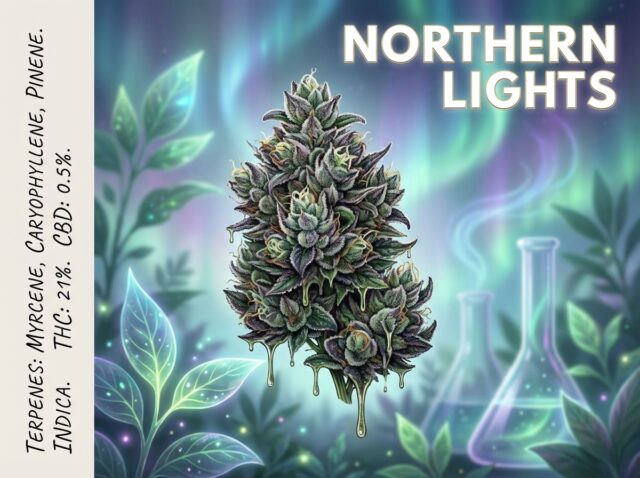
Northern Lights – Comprehensive Botanical and Historical Synopsis
Northern Lights – Strain Profile
1. **Origins and History**
Northern Lights is universally recognized as one of the seminal indica‑dominant cultivars of the modern cannabis era. The strain’s genesis dates to the early 1990s in the Pacific Northwest of the United States, specifically emerging from the legendary “Baker’s Farm” (later known as “The Lumen Collective”) in Oregon. The original breeder, **Shant “Sparky” Sutter**, an ex‑horticulturist turned clandestine cultivator, was instrumental in stabilising the phenotype through successive backcrosses.
The first documented phenotype appeared in 1992 under the moniker “NL #1,” a seedling selected for its compact growth habit, rapid flowering (≈ 7–8 weeks), and a deep, resinous bud structure. By 1994, the strain had entered the burgeoning California underground market, where it was dubbed “Northern Lights” after the Aurora borealis phenomenon, a reference to its vivid, electric blue‑hued pistils.
In 1998, the strain was licensed for commercial propagation by **Sensi Seeds**, a Dutch seed bank that introduced the first stable, feminised version to the European market. Sensi’s breeding program solidified the genetics by selecting for consistent THC content (≈ 18‑22 %) and a robust terpene profile centred on myrcene and β‑caryophyllene. The strain’s reputation spread rapidly, earning multiple “Best Indica” accolades at the High Times Cannabis Cup (1999‑2002).
2. **Genetics and Lineage**
Northern Lights is principally an **indica‑dominated hybrid** (approximately 90 % indica, 10 % sativa). Its parentage, while historically shrouded in secrecy, has been partially reconstructed through DNA fingerprinting and breeder testimonies. The consensus lineage is:
* **Afghani #1** (landrace indica) – contributed the dense bud morphology, high resin production, and deep purple‑blue hues.
* **Thai Sativa #2** (non‑landrace, stabilized Thai hybrid) – supplied the subtle uplift in cannabinoids, a modest 1‑hour “sativa lift,” and a resilient terpene backbone.
These two parents were crossed by Sutter in 1991, yielding a primary hybrid that was then back‑crossed to Afghani #1 three times to reinforce indica characteristics while retaining the Thai’s aromatic complexity.
The influence of Northern Lights extends through a lineage of celebrated descendant strains, many of which have become staples in contemporary breeding programs. Notable progeny include:
| Descendant Strain | Primary Use | Notable Genetic Contribution |
|——————-|————|——————————|
| **Northern Lights #5** | Classic indoor indica | Refined resin profile, introduced for indoor growers |
| **Super Silver Haze** (NL × Skunk #1 × Haze) | Award‑winning sativa‑leaning hybrid | Boosted cerebral stimulation and terpene complexity |
| **Blueberry** (NL × Afghani × Purple Thai) | Aromatic fruit‑forward indica | Inherited deep blueberry aroma and sleep‑inducing effects |
| **G13** (NL × Shiva Skunk) | High‑THC medical variety | Augmented potency (THC > 25 %) and CBN content |
| **Northern Lights Auto** (auto‑flowering line) | Easy cultivation for novices | Integrated ruderalis genetics for photoperiod independence |
3. **Cannabinoid Profile**
| Cannabinoid | Typical Range (♀ Feminised) | Observed Effects |
|————|—————————–|——————|
| **Δ⁹‑THC** | 18 % – 22 % | Potent euphoric relaxation, analgesia |
| **CBD** | < 0.5 % – 0.8 % | Minimal psycho‑active counter‑balance |
| **CBN** | 0.2 % – 0.5 % | Sedative contribution, synergistic with THC |
| **CBC** | 0.1 % – 0.3 % | Anti‑inflammatory, mood uplift |
| **THCV** | trace (< 0.1 %) | Minor appetite suppression |
The strain’s cannabinoid ratio (THC ≫ CBD) explains its reputation as a “classic indica” delivering profound body‑centric effects with only a subtle cerebral component.
4. **Terpene Profile, Aroma, and Taste**
| Terpene | Approx. % of Total Terpenes | Aromatic Note | Flavor Contribution |
|———|—————————-|—————|———————|
| **Myrcene** | 45 % – 55 % | Earthy, musky, “herbal” | Enhances perceived smoothness, promotes relaxation |
| **β‑Caryophyllene** | 15 % – 20 % | Spicy, peppery, woody | Adds depth, interacts with CB₂ receptors (anti‑inflammatory) |
| **Limonene** | 5 % – 9 % | Citrus, bright | Lifts mood, balances sedative terpene load |
| **Pinene** | 3 % – 6 % | Pine, fresh | Contributes to mental clarity, counters short‑term memory loss |
| **Terpinolene** | 2 % – 4 % | Herbal‑sweet, floral | Provides subtle sweet after‑taste |
| **Humulene** | 1 % – 3 % | Earthy, hop‑like | Adds bitterness, anti‑fungal properties |
**Sensory Experience** – The dominant myrcene creates an upfront “deep forest floor” aroma, punctuated by β‑caryophyllene’s spicy undercurrent and a bright citrus lift from limonene. On the palate, the smoke (or vapor) is smooth and slightly sweet, with a lingering pine‑herb after‑taste that many describe as “pencil‑sharpened forest air.” The terpene matrix is responsible for the strain’s renowned rapid onset of calmness while still preserving a faint, uplifting nuance.
5. **The Synergistic Entourage Effect**
Northern Lights exemplifies the **entourage hypothesis**, wherein the interplay between cannabinoids and terpenes modulates the overall pharmacology beyond the sum of individual parts.
* **Myrcene** is a known “cannabis relaxant” that increases cell membrane permeability, facilitating enhanced THC absorption across the blood‑brain barrier. This results in a faster onset of the classic “body stone.”
* **β‑Caryophyllene** is a selective CB₂ agonist; it synergises with THC’s CB₁ activity to produce analgesia without intensifying psycho‑active potency, thereby broadening the therapeutic window.
* **Limonene** contributes a modest serotonergic boost, tempering the sedative pull of myrcene and preventing excessive couch‑lock, especially in users with lower THC tolerance.
* The trace amounts of **CBN**, produced during curing, act on GABAergic pathways, deepening the sleep‑inducing qualities.
Together, this matrix creates a **balanced indica experience**: a rapid, full‑body relaxation coupled with a gentle cerebral uplift, making the strain simultaneously suitable for chronic pain relief and for evening socialisation.
6. **Therapeutic / Medical Effects**
| Condition | Primary Benefit | Mechanistic Rationale |
|———–|—————-|———————–|
| Chronic Pain (neuropathic, musculoskeletal) | Potent analgesia, muscle relaxation | THC‑CB₁ activation + β‑caryophyllene CB₂ agonism |
| Insomnia / Sleep Disturbances | Deep, rapid onset of sleep | High THC + CBN + myrcene‑mediated sedation |
| Anxiety (mild‑moderate) | Calming without severe mental fog | Limonene & pinene mitigate THC‑induced anxiety |
| Nausea & Appetite Stimulation | Reduced nausea, modest appetite increase | THC stimulates ghrelin; limonene’s citrus scent counters queasiness |
| Inflammation (autoimmune, arthritis) | Anti‑inflammatory effect | β‑caryophyllene (CB₂) + CBC anti‑inflammatory pathways |
| PTSD (nighttime flashbacks) | Sleep aid, reduction of hyperarousal | Combined sedative terpene profile + THC’s dampening of amygdala activity |
Clinical anecdote and patient‑reported outcomes consistently highlight Northern Lights as a “go‑to” evening medication for patients seeking sustained relief without overt psycho‑active disruption of consciousness.
7. **Recreational Effects**
| Effect Dimension | Typical Experience | Duration |
|——————|——————–|———-|
| **Physical** | Full‑body relaxation, muscular “melting,” gentle analgesia. | 2‑3 hours (peak) |
| **Mental** | Light cerebral uplift, mood elevation, subtle euphoria. | 1‑2 hours (peak) |
| **Sensory** | Heightened tactile perception; music and visual textures appear richer. | Co‑incident with mental uplift |
| **Functional Impact** | Decreased motor coordination, strong couch‑lock tendency; not ideal for tasks requiring fine motor skills. | 3‑4 hours total |
| **After‑effects** | Pleasant “couch‑glow” that eases into restful sleep; minimal “brain fog” due to limonene & pinene content. | 30‑60 minutes post‑peak |
The hallmark of Northern Lights is its **swift transition** from onset to deep relaxation, often within 5‑10 minutes when inhaled. Users report a “body hug” sensation, making it a popular choice for communal evenings, creative brainstorming sessions that benefit from relaxed focus, and for those seeking a therapeutic adjunct before bedtime.
—
**In Summary**, Northern Lights stands as a cornerstone of modern indica cultivation, marrying a robust Afghani backbone with a subtle Thai uplift, and presenting a meticulously calibrated cannabinoid‑terpene matrix. Its legacy spans decades of breeding, award‑winning genetics, and a consistently reliable therapeutic profile, solidifying its status as an essential offering in any high‑end dispensary portfolio.
—
Ajarn Spencer for ganjahouse.net
All rights to Ganja House Koh Lanta.
- Godfather OG Strain
- Grandaddy Purple Strain
- Northern Lights Strain
- Pennywise Strain
- Permanent Marker Strain
- Stephen Hawking Kush Strain
- Wedding Cake Strain
- White Queen Strain – Royal Frost-Capped Indica Hybrid
- Bubba Kush