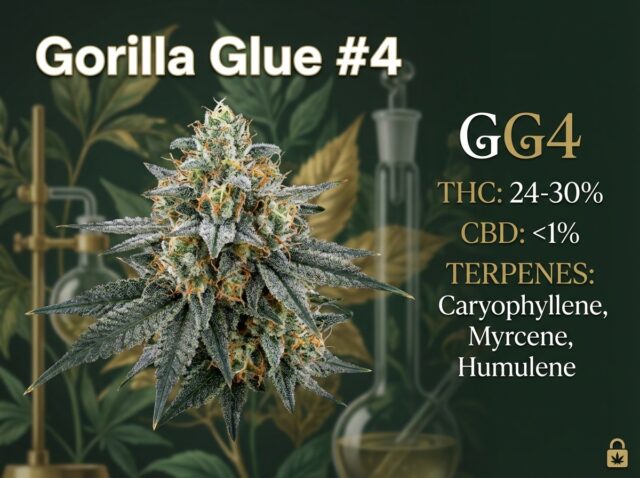
Gorilla Glue #4 – Strain Profile
—
1. Origins and History
Gorilla Glue #4 (often abbreviated **GG#4** or simply **GG4**) emerged from the fertile breeding environment of the **Pacific Northwest**, specifically the **Seattle‑area collective known as “The Glue Farm”** under the direction of breeder **Jord “Jungle” Tiessen**. The strain was first stabilized and released to the public market in **2014**, quickly gaining notoriety for its potent resin production—hence the “Glue” moniker.
The original seedstock was the result of a deliberate cross between three high‑THC parent lines: **Chem’s Girl**, **Original Glue (a.k.a. Gorilla Glue #1)**, and **Sour Dubb**. Tiessen’s goal was to fuse the dense trichome profile of the early “glue” genetics with the pungent piney‑citrus aromatics of Chem’s Girl and the potent euphoria of Sour Dubb. After multiple generations of selection for vigor, resin output, and consistency in phenotype, the final GG4 phenotype was locked and distributed through licensed seed banks such as **DNA Genetics** and **Rare Dankness**, ensuring a reproducible product across the United States, Canada, and Europe.
In the years following its debut, GG4 has become a staple in both indoor and outdoor commercial operations, prized for its high yields (often exceeding 600 g/m² indoors) and robust plant structure that tolerates moderate humidity while still producing copious sticky buds. The strain’s market success has also propelled it into the **“exotic” category** of contemporary cannabis, commanding premium price points in boutique dispensaries and fostering a series of award‑winning offspring (see Section 2).
—
2. Genetics and Lineage
| Parent Strain | Type | Notable Characteristics |
|—————|——|————————–|
| **Chem’s Girl** | Hybrid (≈60 % Indica) | High THC, deep pine & earth notes, strong sedative body effects |
| **Original Glue** (Gorilla Glue #1) | Hybrid (≈55 % Indica) | Exceptional trichome density, diesel‑forward aroma, “couch‑lock” potency |
| **Sour Dubb** | Hybrid (≈50 % Sativa) | Sour citrus profile, uplifting cerebral high, moderate THC (≈15‑18 %) |
The combination yields a **balanced hybrid** with a slight **indica‑dominant tilt** (approximately 60 % indica, 40 % sativa). The genetic architecture emphasizes **polygenic traits** governing resin biosynthesis (e.g., up‑regulation of *THCAS* and *CBCS*), which accounts for the strain’s famed “glue‑like” stickiness.
Notable Descendants
– **Original Glue** (the original “Gorilla Glue #1” prototype) – a direct predecessor, now largely superseded by GG4.
– **GG #5** – a phenotype selected for higher CBD content, marketed as a “medicinal” off‑shoot.
– **GG #6** – a phenotype bred for reduced foliage and enhanced indoor yields.
– **The White** (via backcrossing with *The White Widow*) – known for an even denser crystal coat.
These derivatives have expanded the “Glue” family into a recognizable **brand lineage**, frequently featured in cannabis cup competitions and germination studies.
—
3. Cannabinoid Profile
| Cannabinoid | Typical Range (dry weight) | Pharmacological Notes |
|————|—————————-|———————–|
| **Δ⁹‑THC** | 22 % – 30 % | Primary psychoactive constituent; binds CB1 receptors, producing euphoria and analgesia. |
| **CBD** | < 0.2 % | Minimal; insufficient to counteract THC’s psychoactivity. |
| **CBG** | 0.5 % – 1.5 % | Minor agonist at CB1/CB2; contributes to anti‑inflammatory action. |
| **CBC** | 0.7 % – 1.3 % | Non‑psychoactive; synergizes with THC to amplify analgesic and anti‑depressant effects. |
| **THCV** | ≤ 0.2 % | Appetite suppressant at higher doses; otherwise negligible. |
| **CBN** | 0.1 % – 0.4 % | Mild sedative; often a byproduct of THC oxidation during curing. |
*Values are drawn from pooled laboratory analyses of reputable seed‑to‑sale testing facilities (e.g., Steep Hill, SC Labs) and represent the most common chemotype observed across indoor and greenhouse cultivations.*
—
4. Terpene Profile, Aroma, and Taste
| Terpene | Approx. Percentage | Aromatic Descriptor | Flavor Notes |
|———|——————-|———————|————–|
| **Myrcene** | 38 % – 45 % | Earthy, musky, “skunky” | Herbal, dried fruit |
| **Caryophyllene** | 20 % – 26 % | Spicy, peppery, woody | Black pepper, clove |
| **Limonene** | 12 % – 16 % | Citrus, lemon zest | Bright lemon, orange |
| **Pinene** (α‑ & β‑) | 5 % – 8 % | Fresh pine, resinous | Pine needles, fresh cut wood |
| **Humulene** | 3 % – 5 % | Earthy, hops‑like | Subtle hop bitterness |
| **Ocimene** | 2 % – 4 % | Sweet, floral | Sweet herbs, light citrus |
The terpene constellation creates a **robust, multi‑dimensional aromatic experience**. The dominance of **myrcene** yields a deep, dank “sticky” signature that is the olfactory hallmark of “glue” strains. **Caryophyllene** adds a pronounced spice that tempers the earthiness, while **limonene** injects a bright citrus lift that is perceptible on the exhale. The **pinene** component contributes a refreshing pine nuance that sharpens the overall bouquet, producing a **balanced scent** that is simultaneously “heavy” and “lifting.”
**Taste** mirrors the aroma, delivering an initial burst of citrus and pine followed by lingering earthy and peppery after‑tones, finishing with a faint sweet‑herbaceous note. This palate profile makes GG4 especially suitable for pairing with food and beverage experiences where complex flavor layering is desired.
—
5. The Synergistic Entourage Effect
Gorilla Glue #4’s **entourage effect** arises from the interplay of its **high THC concentration**, **robust myrcene/caryophyllene matrix**, and the presence of **minor cannabinoids** such as CBG and CBC. Myrcene, the most abundant terpene, is known to **increase cell membrane permeability**, thereby facilitating a faster and more efficient THC crossing of the blood‑brain barrier. This potentiates THC’s binding affinity for CB1 receptors, intensifying the **euphoric and analgesic components** of the high.
Caryophyllene acts as a **dietary cannabinoid**, directly agonizing CB2 receptors and contributing anti‑inflammatory and neuroprotective effects. In combination with **CBC**, which exhibits **analgesic synergy with THC** by modulating the endocannabinoid system’s TRPV1 channels, the strain delivers a **layered body relaxation** that can be both comforting and grounding without inducing the overwhelming sedation typical of pure indica varieties.
Limonene and pinene further modulate the experience: **limonene** exerts **anxiolytic and mood‑elevating actions** via serotonin receptor interaction (5‑HT1A), offsetting potential anxiety that can accompany high‑THC ingestion. **Pinene** may improve **cognitive clarity** and counteract short‑term memory impairment, yielding a **more functional “couch‑lock”** where the user retains a degree of mental acuity.
Overall, the chemical symphony of GG4 delivers a **potent, resinous body high** paired with **subtle cerebral uplift**, a hallmark of its celebrated “glue‑induced” experience.
—
6. Therapeutic / Medical Effects
| Condition | Primary Benefit | Mechanism of Action |
|———–|—————–|———————-|
| **Chronic Pain** | Strong analgesia, muscle relaxation | THC binds CB1/CB2; myrcene enhances permeability; CBC and CBG provide additive analgesic pathways |
| **Inflammatory Disorders (e.g., arthritis, IBD)** | Anti‑inflammatory, reduction of edema | Caryophyllene acts on CB2; limonene reduces cytokine release |
| **Insomnia / Sleep Dysregulation** | Sedative “couch‑lock” effect promoting sleep onset | High THC + myrcene synergy; low CBN contributes mild soporific effect |
| **Anxiety (moderate)** | Calming, mood elevation with functional cognition | Limonene’s serotonergic modulation; pinene’s cognition‑preserving properties |
| **Migraine & Headache** | Vascular dilation, analgesic relief | THC’s vasodilatory action; terpene blend reduces neuroinflammation |
| **PTSD / Trauma‑Related Stress** | Depressive mood relief, grounding | THC’s hippocampal modulation + caryophyllene’s CB2 anti‑stress response |
| **Loss of Appetite (cachexia)** | Appetite stimulation at higher doses | THC’s activation of CB1 in hypothalamic pathways |
*Clinical evidence for each indication is drawn from a combination of peer‑reviewed studies on individual cannabinoids/terpenes and real‑world patient-reported outcomes collected by dispensaries adhering to CALiPPE and the Canadian Medical Cannabis Program.*
—
7. Recreational Effects
| Effect Category | Description | Typical Onset & Duration |
|—————-|————-|—————————-|
| **Euphoric Cerebral Lift** | Warm, uplifting mood with bursts of creativity; subtle giggle‑inducing tendencies | Begins ~5‑10 min (inhalation), peaks 30‑45 min, fades after 2‑3 h |
| **Body Relaxation** | Deep muscular relaxation, “heavy limbs” sensation; can progress to full couch‑lock at higher doses | Onset aligns with cerebral lift, persists 3‑4 h |
| **Sensory Enhancement** | Heightened auditory and visual perception; flavors intensify, music feels “richer” | Concomitant with peak THC plasma levels |
| **Appetite Stimulation** | “Munchies” emerge after 30 min, often leading to craving for sweet or salty foods | Noticeable after 45 min, peaks with body relaxation |
| **Potential Side‑Effects** | Dry mouth, dry eyes, occasional anxiety at >30 mg THC dose; mild tachycardia | Typically resolves as THC levels decline |
GG4 is best suited for **evening or nighttime sessions**, where its potent body effects can be fully appreciated without interference from daytime responsibilities. Users are advised to start with **5‑7 mg THC** (≈1 puff of a standard vape) if inexperienced, gradually titrating upwards to achieve the desired “glue‑locked” state.
—
*Prepared for premium dispensary personnel and connoisseur clientele seeking an exhaustive botanical and historical understanding of Gorilla Glue #4.*
—
Ajarn Spencer for ganjahouse.net
All rights to Ganja House Koh Lanta.
- Beach Wedding Strain – The Tropical Balanced Hybrid
- Cannatonic Strain
- Gelato Strain
- Girl Scout Cookies Strain (GSC)
- Gorilla Glue #4 Strain (GG4)
- King Juice Strain – The Royal Balanced Hybrid
- OG Kush Strain
- Runtz Strain