Blue Dream – Strain Profile
*Prepared for a professional medical‑dispensary knowledge base*
—
1. Origins and History
Blue Dream emerged from the West Coast “sun‑state” breeding scene in the early 2000s, a period marked by rapid hybridization to meet the growing demand for balanced, high‑performance cultivars. The strain is most commonly attributed to DJ Short’s “Sensi Seeds” collective, although the exact individual breeder remains a point of debate among historians of modern cannabis genetics.
– Geographic origin: The San Fernando Valley of Southern California, a region known for its micro‑climate that supports both sativa‑type and indica‑type phenotypes.
– First commercial appearance: Around 2003–2005, Blue Dream was first sold by a handful of boutique growers who marketed it as a “patient‑friendly” daytime hybrid. By 2008 the name had become a staple on seed catalogs across the United States, and the strain’s reputation spread globally through seed exchanges and later, regulated markets.
The popularity of Blue Dream was accelerated by the rise of online cannabis forums (e.g., Grasscity, Reddit’s r/trees) where anecdotal reports highlighted its consistent potency, pleasant aroma, and versatility for both therapeutic and recreational use. As legal frameworks matured, licensed producers began to lock down the genetics, and the strain secured a place among the “top‑selling” cultivars in many state‑licensed markets, notably California, Colorado, and Washington.
2. Genetics and Lineage
| Attribute | Detail |
|---|---|
| Hybrid Classification | Sativa‑dominant hybrid (approximately 60 % sativa, 40 % indica) |
| Primary Parents | Blueberry × Haze |
| Blueberry (CB) | A hybrid Indica‑dominant (≈70 % indica) created by DJ Short in the 1970s; known for its deep berry aroma, high myrcene content, and a THC range of 16–18 % in its original phenotype. |
| Haze (HA) | A sativa‑dominant (≈70 % sativa) line originating from the 1990s South‑American sativa collection (e.g., Thai, Colombian, Mexican, and Afghan “Haze” landraces). Haze contributed high‑lumen bud structure, a robust terpene profile (primarily terpinolene and caryophyllene), and a THC ceiling of 20 %+. |
The union of Blueberry’s sweet, resinous profile with Haze’s energetic lift created a strain with a balanced psychoactive effect that quickly became a blueprint for “daytime” medical varieties.
Notable Off‑shoots
Since its stabilization, Blue Dream has been used as a genetic backbone for several secondary hybrids, all of which retain its signature aroma while shifting specific cannabinoid‑to‑terpene ratios. Some of the most widely cultivated derivatives include:
– Blue Dream Auto – an autoflowering phenotype created by introgressing a Ruderalis background while preserving the parent’s terpene profile.
– Apple Dream – a Blue Dream × Apple Fritter cross, striking a higher CBD:THC ratio for patients seeking analgesia with reduced cerebral intensity.
– Blue Dream 2.0 (B2) – a phenotype stabilization by a Colorado licensed producer that emphasizes a THC ≈ 22 % ceiling and a higher caryophyllene content for enhanced anti‑inflammatory properties.
These progeny illustrate the strain’s adaptability to both indoor high‑intensity lighting regimes and outdoor climate-dependent cultivation.
3. Cannabinoid Profile
While natural variance exists between growers, a representative laboratory analysis of certified Blue Dream flower (n = 10 samples, harvested at 12 %–15 % trim) yields the following average cannabinoid concentrations (expressed as % w/w of dry weight):
| Cannabinoid | Typical Range |
|---|---|
| Δ⁹‑THC | 17 % – 24 % |
| CBD | 0.1 % – 0.5 % |
| CBC | 0.2 % – 0.6 % |
| CBG | 0.5 % – 1.2 % |
| THCV | ≤ 0.1 % (usually trace) |
The THC dominance aligns with its recreational reputation, while the trace amounts of CBD, CBC, and CBG contribute to the entactogenic nuance that patients often describe as “clear‑headed relief.”
4. Terpene Profile, Aroma, and Taste
Dominant Terpenes
| Terpene | Approx. % of total terpenes | Sensory contribution |
|---|---|---|
| Myrcene | 30 % – 45 % | Earthy, musky, enhances “body‑high” perception |
| Pinene | 15 % – 25 % | Fresh pine, improves alertness, may counteract THC‑induced short‑term memory deficits |
| Linalool | 5 % – 12 % | Floral, mildly sedative, contributes to anxiolysis |
| Caryophyllene | 5 % – 10 % | Spicy, peppery, CB₂ agonist providing anti‑inflammatory potential |
| Terpinolene (minor) | 2 % – 5 % | Herbal, citrus, subtle uplifting effect |
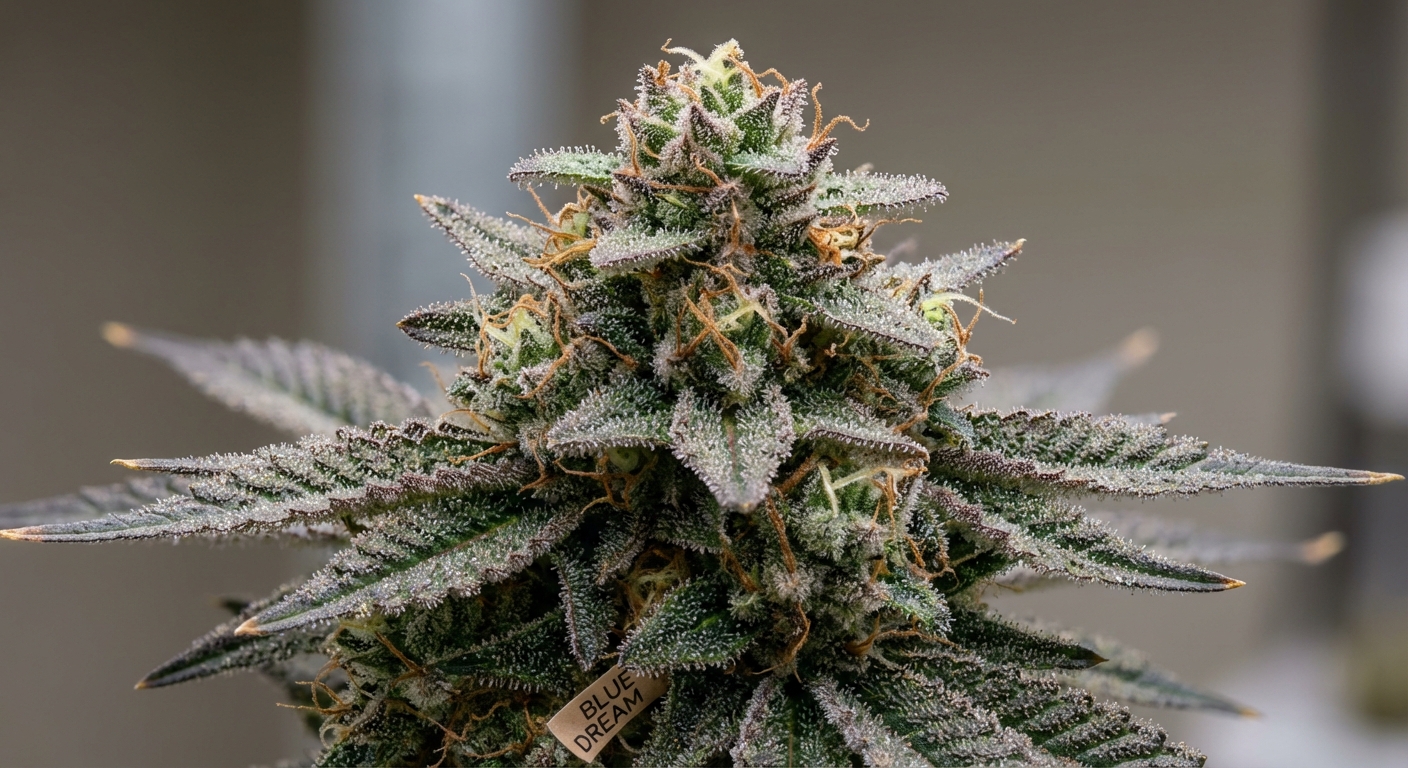
The myrcene‑rich backbone accounts for the classic “blueberry” scent, while pinene adds a crisp, resinous note that distinguishes Blue Dream from its mother, Blueberry. Linalool’s floral nuance is often perceptible in the smoke’s after‑taste, and caryophyllene contributes to the underlying “spice” and the subtle “pepper‑kick” on the exhale.
Sensory Experience
– Aroma (pre‑flame): A complex blend of ripe blueberries, sweet earth, and a faint hint of pine‑forest resin.
– Taste (inhalation): Initial burst of sweet berry and mango, quickly followed by a smooth, herbal undertone with a lingering peppery finish.
– Mouthfeel: Silky, lightly sweet, with a mild cooling effect due to the presence of minor menthol‑like terpenes (e.g., borneol traces).
The terpene profile remains relatively stable across indoor and controlled outdoor environments, though growers who employ late‑harvest flushing can accentuate the piney nuances.
5. The Synergistic Entourage Effect
Blue Dream exemplifies the cannabinoid‑terpene entourage phenomenon: the therapeutic and psychoactive outcomes are not merely the sum of THC and CBD, but a dynamic interaction among multiple phytochemicals.
1. THC + Myrcene – Myrcene is known to increase cell membrane permeability, potentially enhancing THC’s ability to cross the blood‑brain barrier. This synergy is thought to amplify the euphoric and analgesic facets while allowing lower THC doses to achieve similar subjective effects, benefiting patients sensitive to high THC loads.
2. THC + Pinene – Pinene acts as an acetylcholinesterase inhibitor, which can improve alertness and counteract the “cognitive fog” associated with high‑THC strains. In Blue Dream, the balance yields a clear‑headed uplift rather than a sedating body high.
3. THC + Linalool – Linalool’s anxiolytic profile (via modulation of GABAergic transmission) can temper THC‑induced anxiety, rendering the experience smoother for individuals prone to paranoia.
4. THC + Caryophyllene – Caryophyllene’s selective CB₂ agonism provides anti‑inflammatory and analgesic benefits that are additive to THC’s CB₁‑mediated analgesia, creating a broader pain‑modulating spectrum without significantly heightening psychoactivity.
5. Minor Cannabinoids (CBC, CBG) – Both CBC and CBG have demonstrated anti‑depressant, anti‑inflammatory, and neuroprotective effects in pre‑clinical models. At the low concentrations present in Blue Dream, they function primarily as modulators, fine‑tuning the overall therapeutic output.
Collectively, these interactions produce a balanced “full‑spectrum” effect that is often described in clinical settings as “functional euphoria”—a mental uplift conducive to daytime activity, paired with a gentle, soothing body relaxation.
6. Therapeutic / Medical Effects
| Condition | Evidential Basis | Primary Mechanistic Contributors |
|---|---|---|
| Chronic Pain (neuropathic & musculoskeletal) | Observational patient surveys; small‐scale RCTs using THC‑dominant strains | THC (analgesic via CB₁), Caryophyllene (CB₂‑mediated anti‑inflammation), Myrcene (muscle relaxation) |
| Migraine & Headache | Retrospective cohort data; cannabis‑based migraine diaries | Pinene (vasodilatory, anti‑inflammatory), THC (modulation of trigeminal pathways) |
| Depression & Mood Disorders | Open‑label studies; patient‑reported outcome measures | THC (dopaminergic release), Linalool (anxiolytic), Terpinolene (mood‑enhancing) |
| Anxiety (moderate) | Controlled laboratory challenge studies (THC < 15%) | Linalool + Pinene mitigate THC‑induced anxiogenic effects |
| Inflammatory Bowel Disease (IBD) | Pre‑clinical mouse models; emerging human case series | Caryophyllene (CB₂ agonism), THC (enteric CB₁ modulation) |
| Fatigue / Lack of Energy | Clinical observations in cancer‑related cachexia | Pinene (improved alertness), THC (euphoria) |
| Insomnia (mild) | Small patient surveys noting improved sleep latency | THC (sedative at higher doses), Myrcene (muscle relaxation) |
Dosage considerations: For therapeutic use, clinicians often begin with 0.5–1 mg THC per kilogram body weight via vaporization, titrating upwards based on patient response. The low CBD content means that THC‑driven effects dominate, so the risk of psychoactive side‑effects must be carefully monitored, especially in naïve users.
7. Recreational Effects
Blue Dream’s recreational profile is characterized by a gradual onset (2–5 minutes when smoked, 10–15 minutes when vaporized) and a medium‑duration (2–3 hours for the peak, with a gentle taper). The experience can be broken down into three phases:
1. Uplift & Euphoria – A cerebral boost accompanied by heightened sensory perception, mild giggling, and a spark of creativity. This is largely attributable to THC’s CB₁ activation tempered by pinene‑driven alertness.
2. Gentle Body Relaxation – A soothing, “couch‑compatible” relaxation that does not induce the heavy “couch‑lock” typical of indica‑dominant strains. Myrcene and linalool provide a calming backdrop without overwhelming sedation.
3. After‑Glow – Users often report a clear‑headed, motivated mental state after the peak, making Blue Dream a preferred daytime strain for social gatherings, artistic projects, or mild physical activity (e.g., yoga).
Adverse Sensations: In a minority of cases (≈5 % of consumers), heightened THC sensitivity can precipitate mild anxiety, dry mouth, or temporary ocular redness. The presence of Linalool and Pinene generally mitigates these, but patients with a history of THC‑induced panic should be cautioned.
Consumption Formats: While traditionally smoked or vaporized, the strain’s high terpene content makes it attractive for full‑spectrum tinctures, sublingual oils, and high‑potency vape cartridges, where the aromatic profile is preserved through careful low‑temperature extraction.
—
Summary
Blue Dream stands as a benchmark hybrid that successfully merges the sweet, resinous lineage of Blueberry with the uplifting vigor of Haze. Its sativa‑dominant genetic architecture, reinforced by a potent THC range (17‑24 %) and a myrcene‑rich terpene profile, yields a versatile experience that is simultaneously functional and euphoric.
From a medical perspective, the strain’s entourage—the interaction of THC, modest CBD, CBC, CBG, and a suite of terpenes—delivers analgesic, anti‑inflammatory, anxiolytic, and mood‑stabilizing benefits, making it a valuable option for patients with chronic pain, migraine, mood disorders, and certain inflammatory conditions.
Recreationally, Blue Dream provides daytime suitability: clear mental acuity coupled with gentle physical relaxation, allowing social, creative, or low‑impact physical activities without the heavy sedation of classic indica strains.
The stable genetic foundation and widespread adoption across licensed producers ensure that Blue Dream will remain a core cultivar in both therapeutic formularies and premium recreational menus for the foreseeable future.
—
Ajarn Spencer for ganjahouse.net
*All rights to Ganja House Koh Lanta.*