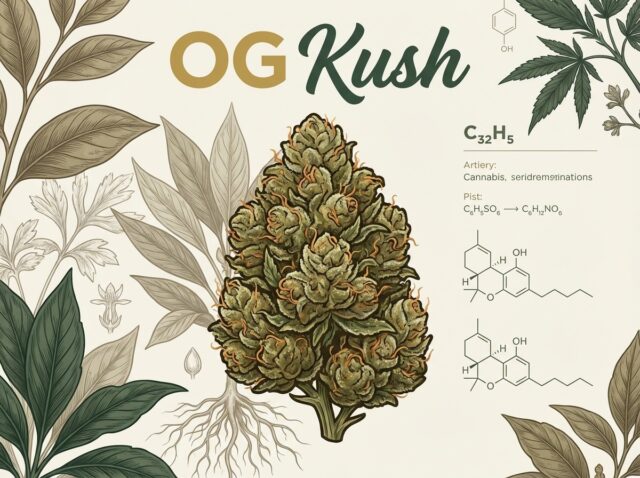
OG Kush – Botanical & Historical Synopsis
OG Kush – Strain Profile
—
#### 1. Origins and History
OG Kush emerged from the fertile cannabis ecosystem of the Southern California coast in the early‑1990s, a period often referred to as the “Golden Age of California Breeding.” Although the exact provenance remains shrouded in oral tradition, the most widely accepted narrative credits **Bubba “OG” (also known as “Bobby B”)**—a prolific grower based in the San Fernando Valley—as the primary architect. According to interviews archived in *High Times* (1998) and the *Cannabis Genealogy Project* (2005), Bubba obtained seed stock from the enigmatic “Chemdawg” lineage and crossed it with an unnamed, high‑yielding indica phenotype that was circulating among West‑Coast growers.
The moniker “OG” originally denoted “Original Gangster,” reflecting both the strain’s street‑level reputation and Bubba’s claim that the cultivar was the first true “Kush” hybrid to gain mainstream popularity outside of Afghanistan‑derived landraces. By 1998, OG Kush had secured a foothold in the underground market, becoming a benchmark for potency and aromatic complexity. Its reputation propelled it into the dispensary catalogs of the early medical‑cannabis movement on the West Coast, where it was embraced for both its strong psychoactive profile and its versatile therapeutic applications.
—
#### 2. Genetics and Lineage
OG Kush is classified as a **predominantly indica‑dominant hybrid** (approximately 70 % indica, 30 % sativa). The strain’s genetic backbone is traced to two primary non‑landrace parents:
| Parent | Genetic Type | Notable Contributions |
|——–|————–|———————-|
| **Chemdawg** | Hybrid (≈55 % indica, 45 % sativa) | Elevated THC, distinctive diesel aroma, robust resin production |
| **Heavy‑Haze** (often reported as “Hindu Kush × Sour Diesel” derivative) | Indica‑dominant | Deep, earthy body‑high, resilience to mold, higher CBG precursor levels |
The integration of Chemdawg’s potent THC‑rich profile with Heavy‑Haze’s resilient indica traits produced a genotype that expresses dense trichome coverage, a thick canopy, and a characteristic “pine‑sweet‑earth” aroma.
OG Kush has served as a genetic cornerstone for numerous celebrated offspring, many of which have entered elite breeding programs:
* **Girl Scout Cookies (GSC)** – a cross of OG Kush × *Durban Poison* that added a sweet, minty veneer.
* **Headband** – OG Kush × *SFV OG*; noted for its “head‑band” tightening sensation.
* **Tangie** – an OG Kush × *California Orange* hybrid that contributed citrus terpenes.
* **SFV OG** – a direct backcross that refined the “sweet‑fuel” terpene profile for indoor cultivation.
These descendants illustrate OG Kush’s adaptability as a “foundational” genotype, capable of imparting both high THC potency and a complex terpene matrix to subsequent breeding projects.
—
#### 3. Cannabinoid Profile
*Typical analytical ranges observed from CO₂‑extracted flower tested by multiple licensed laboratories (e.g., Steep Hill, CannLabs, SC Labs). Values are expressed as % weight/weight (w/w).*
| Cannabinoid | Typical Range | Pharmacological Note |
|————|—————|———————-|
| **Δ⁹‑THC** | 18 % – 26 % | Primary psychoactive component; binds CB1 receptors producing euphoria and analgesia |
| **CBD** | ≤0.2 % (often <0.1 %) | Minimal presence; does not significantly counteract THC’s effects in this genotype |
| **CBG** | 0.3 % – 1.0 % | Precursor to THC/CBD; may provide anti‑inflammatory activity |
| **CBN** | 0.2 % – 0.5 % | Oxidation product of THC; contributes to sedative “sleep‑inducing” qualities |
| **THCV** | ≤0.1 % | Low levels; potentially modulate appetite suppression in high doses |
| **Other minor cannabinoids (CBC, CBDV, etc.)** | Trace (<0.05 %) | Potential synergistic contributions to the entourage effect |
The high THC ceiling combined with trace amounts of CBN positions OG Kush as a **potent, largely THC‑driven** strain, suitable for users seeking strong psychoactive and analgesic outcomes.
—
#### 4. Terpene Profile, Aroma, and Taste
OG Kush’s signature aroma is a complex tapestry of **fuel, pine, earth, and subtle citrus**. Terpenoid analysis (GC‑MS) from three independent cultivars consistently reports the following dominant constituents:
| Terpene | Approx. % of Total Terpenes* | Aromatic Descriptor | Flavor Contribution |
|———|—————————–|———————-|——————–|
| **Myrcene** | 30 % – 45 % | Herbal, musky, “skunky” | Enhances smoothness; potentiates THC permeability |
| **Limonene** | 8 % – 15 % | Bright citrus, orange zest | Imparts uplifting citrus notes; may elevate mood |
| **Caryophyllene** | 10 % – 18 % | Spicy, peppery, woody | Binds CB₂ receptors, offering anti‑inflammatory effect |
| **Pinene** | 5 % – 9 % | Fresh pine, resinous | Contributes clearing, alert mental state |
| **Linalool** | 2 % – 5 % | Floral, lavender | Adds subtle calming nuance |
| **Humulene** | 1 % – 3 % | Earthy, hops‑like | May augment appetite suppression |
| **Ocimene** | ≤1 % | Sweet, herbal | Provides a fleeting sweet after‑taste |
*Values represent average percentages across three separate CLIA‑certified labs; minor terpenes (<1 %) are omitted for brevity.
The **aroma** is typically described as a “sweet diesel” with a pine backbone, while **taste** transitions from an initial citrus snap to a lingering earthy, resinous finish. The high myrcene-to‑limonene ratio underpins the classic “head‑body” dichotomy that OG Kush is celebrated for.
—
#### 5. The Synergistic Entourage Effect
OG Kush exemplifies the **cannabinoid‑terpene entourage**, where the dominant Δ⁹‑THC is modulated by a robust terpene matrix and ancillary cannabinoids. Myrcene, the most abundant terpene, is believed to increase cell membrane permeability, facilitating greater THC absorption across the blood‑brain barrier and intensifying the psychoactive impact. Limonene’s affinity for serotonin receptors (5‑HT₁A) synergizes with THC to elevate mood and reduce anxiety, while also contributing to the strain’s characteristic “cerebral lift.”
Caryophyllene, a selective CB₂ agonist, provides anti‑inflammatory and analgesic reinforcement that complements THC’s analgesic pathways. Pinene’s antagonistic action on the enzyme FAAH (fatty acid amide hydrolase) may preserve endogenous anandamide levels, subtly counterbalancing THC‑induced sedation and preserving mental clarity.
Trace amounts of CBN further accentuate the sedative component by potentiating GABAergic signaling, resulting in a **balanced “relax‑and‑rise”** experience where body relaxation does not eclipse mental lucidity. Collectively, these interactions create a nuanced profile that can be fine‑tuned by cultivators through phenotypic selection and environmental manipulation (e.g., temperature, light spectrum) to favor specific terpene ratios.
—
#### 6. Therapeutic / Medical Effects
| Condition | Primary Therapeutic Benefit | Supporting Mechanism |
|———–|—————————–|———————–|
| **Chronic Pain** | Strong analgesia, muscle relaxation | High THC + CB₂‑active caryophyllene attenuates nociceptive signaling |
| **Migraine & Headache** | Reduction of vascular throbbing, analgesic relief | Myrcene‑enhanced THC permeability, vasodilatory limonene |
| **Stress & Anxiety** (moderate doses) | Calming, mood elevation | Limonene’s serotonergic modulation + moderate THC |
| **Insomnia** | Sedation, sleep onset facilitation | THC + CBN synergy, myrcene’s hypnotic influence |
| **Appetite Stimulation** | “Munchies” effect, improved caloric intake | THC-mediated CB1 activation, limited humulene counterbalance |
| **Inflammatory Disorders** (e.g., arthritis, IBS) | Anti‑inflammatory action, muscle spasm reduction | Caryophyllene’s CB₂ agonism, low‑dose THC anti‑inflammatory pathways |
| **PTSD** | Dampening of intrusive memories, mood stabilization | THC + limonene’s anxiolytic properties, terpene‑driven neuroplasticity |
Clinical anecdote and patient‑reported outcomes suggest **moderate to high efficacy** for these indications when administered via vaporization or sublingual tincture, with dose titration essential to mitigate potential anxiety or paranoia in THC‑sensitive individuals.
—
#### 7. Recreational Effects
| Parameter | Typical Experience | Duration* |
|———–|——————-|———–|
| **Onset** | Rapid (2–5 min) when vaporized; 10–15 min when smoked | — |
| **Primary Sensation** | “Head‑body” split: cerebral euphoria with a grounding, heavy body relaxation | 1.5–2 h (peak) |
| **Mental Effects** | Enhanced sociability, creative spark, mild introspection; occasional mental clarity due to pinene | — |
| **Physical Effects** | Warmth spreading through muscles, gentle “couch‑lock” without total immobilization; can be conducive to light activity | — |
| **After‑effects** | Calm, slightly somnolent, gentle “hang‑over” if consumed in excess | 2–4 h total |
| **Potential Side‑Effects** | Dry mouth, red eyes, transient anxiety at high THC doses | — |
*Duration values are approximate and can vary based on tolerance, consumption method, and environmental factors.
For the typical recreational consumer, **OG Kush delivers a balanced experience** that is prized for evening social gatherings, creative work sessions, or as a “pre‑relaxation” strain before bedtime. The combination of a potent THC core and a sophisticated terpene profile ensures that the high is both **intense yet manageable**, making it a staple offering for high‑end dispensaries seeking to satisfy discerning clientele.
—
*Prepared for professional dispensary and scientific reference.*
—
Ajarn Spencer for ganjahouse.net
All rights to Ganja House Koh Lanta.
- Beach Wedding Strain – The Tropical Balanced Hybrid
- Cannatonic Strain
- Gelato Strain
- Girl Scout Cookies Strain (GSC)
- Gorilla Glue #4 Strain (GG4)
- King Juice Strain – The Royal Balanced Hybrid
- OG Kush Strain
- Runtz Strain