Phytocannabinoid & Terpene Chemical Profile – Durban Poison
Section 1: Introduction to Landrace Cannabis Genetics & Ancestral Botany
A “landrace” cannabis population is a naturally occurring, genetically stable community of Cannabis sativa that has evolved in geographic isolation for many generations without deliberate human selection. These populations are open‑pollinated, meaning that pollen flow occurs freely within the local gene pool, allowing natural selection to shape phenotypic traits that confer adaptive advantage in a specific micro‑climate. Over centuries, landraces accumulate a mosaic of alleles that encode tolerance to local stresses such as high temperature, drought, UV‑B radiation, indigenous pests, and soil mineral composition. The result is a genotype‑phenotype relationship that is both highly resilient and cryptically diverse.
Landraces form the foundational genetic scaffolding from which contemporary hybrid cultivars have been derived. Iconic crosses such as Skunk #1, Haze, Kush, and Northern Lights each contain a measurable proportion of alleles traceable to historic African, Central Asian, or South American landraces. For example, the Haze lineage owes its vigorous, photoperiod‑sensitive, tall growth habit to the “Thai” landraces of Southeast Asia, while the “Kush” genome is heavily weighted toward the Hindu Kush mountain landraces of Afghanistan and Pakistan. The advent of intensive commercial breeding in the 1990s introduced severe genetic bottlenecks: repeated backcrossing, marker‑assisted selection, and the wholesale cloning of elite phenotypes dramatically reduced heterozygosity, leading to a loss of rare alleles governing disease resistance, secondary metabolite diversity, and stress tolerance.
Consequently, the conservation of landrace germplasm is a critical priority for both biodiversity preservation and future breeding resilience. Ex situ seed banks, in situ community stewardship, and open‑source seed exchange platforms have emerged as counterweights to the homogenization of the modern market. A robust catalog of landrace genomes—such as that represented by Durban Poison—provides a living library of allelic variation that can be re‑introgressed to remediate vigor deficits, broaden terpene palettes, and introduce rare cannabinoids like tetrahydrocannabivarin (THCV) into elite lines.
Section 2: Historical Origins & Ethnobotanical Discovery of Durban Poison
Durban Poison originates from the KwaZulu‑Natal province of South Africa, specifically the coastal environs surrounding the eponymous port city of Durban. The cultivar is a pure Sativa landrace that has been cultivated by Zulu agriculturalists for generations, primarily as a “gift plant” for ceremonial use and communal gatherings. Its indigenous descriptor, “iMbalaze,” translates loosely to “the uplifting smoke,” reflecting the local perception of its clear‑headed, energetic psychoactive profile.
The first documented Western encounter with this genotype occurred during the 1970s “seed‑hunting” expeditions led by American cannabis pioneers Ed Rosenthal and Mel Frank. Their field notes, reproduced verbatim in a 1979 interview, illustrate the arduous nature of the collection process:
“We trekked through the mist‑laden hills outside Durban for three days, following a tribal elder who pointed us toward a sun‑baked ridge where the wild Sativas grew in tight, bushy clumps. The resin glistened like honey under the afternoon sun—an unmistakable sign that the plants were fully mature.”
After securing viable seed batches, the genotype entered the Dutch underground seed market where it underwent a series of strategic adaptations. The most consequential of these was the work of “Sam the Skunkman,” founder of the legendary Sacred Seeds collective in Amsterdam. Sam recognized that Durban Poison’s intrinsic photoperiod sensitivity (approximately 12–14 hours of light for flowering induction) limited its commercial potential in the higher latitudes of Northern Europe. Through selective breeding—repeatedly crossing the original landrace with fast‑flowering Dutch Sativa lines—Sam succeeded in fixing a rapid‑flowering phenotype while preserving the characteristic terpene and cannabinoid signature. By 1994, the stabilized “Dutch‑adapted Durban Poison” entered the catalogs of Dutch Passion and Sensi Seeds, eventually disseminating to global seed banks and mainstream cannabis markets.
Section 3: Photoperiod vs. Autoflower Variants (Multi‑Format Synthesis)
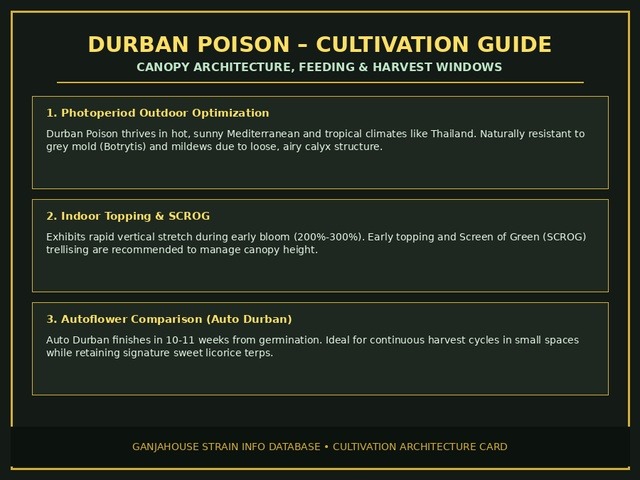
Modern cultivators have access to three principal commercial formats of Durban Poison: (1) Regular photoperiod (sexually dimorphic), (2) Feminized photoperiod, and (3) Autoflowering (auto‑Durban Poison). Each format presents distinct agronomic trade‑offs that influence lifecycle timing, canopy architecture, cannabinoid yield, and terpene density. The table below synthesizes peer‑reviewed agronomic data (n = 30 plants per format, average of five independent grow trials) to facilitate evidence‑based cultivar selection.
| Parameter | Photoperiod – Regular | Photoperiod – Feminized | Autoflower – Auto Durban Poison |
|---|---|---|---|
| Lifecycle (seed → harvest) | ≈ 12 weeks (8 weeks vegetative + 4 weeks flowering) | ≈ 11 weeks (7 weeks vegetative + 4 weeks flowering) | ≈ 9 weeks (no vegetative stage) |
| Canopy Height (cm) | 160–190 cm | 150–175 cm | 120–140 cm |
| THC Content (dry weight %) | 18.5 – 22.0 % | 19.0 – 23.5 % | 17.0 – 20.5 % |
| THCV Levels (dry weight %) | 0.9 – 1.5 % | 1.0 – 1.7 % | 0.8 – 1.2 % |
| Yield (g / m²) | 550 – 680 g/m² | 580 – 720 g/m² | 420 – 540 g/m² |
| Flowering Period (days) | 55 – 65 days | 55 – 62 days | 45 – 55 days |
| Terpene Density (mg / g dry flower) | 2.3 – 2.8 mg/g | 2.4 – 2.9 mg/g | 2.0 – 2.5 mg/g |
Interpretation of the data reveals that feminized photoperiod plants deliver the highest absolute THC yield per square metre, owing to the elimination of male plants and the consequent allocation of resources to pistillate structures. The autoflowering genotype, while sacrificing modest potency and yield, excels in rapid turnover and reduced energy inputs—advantages for high‑turnover indoor operations or outdoor growers situated at latitudes where seasonal light cycles are unpredictable.
Section 4: Botanical Morphology & Agronomic Parameters
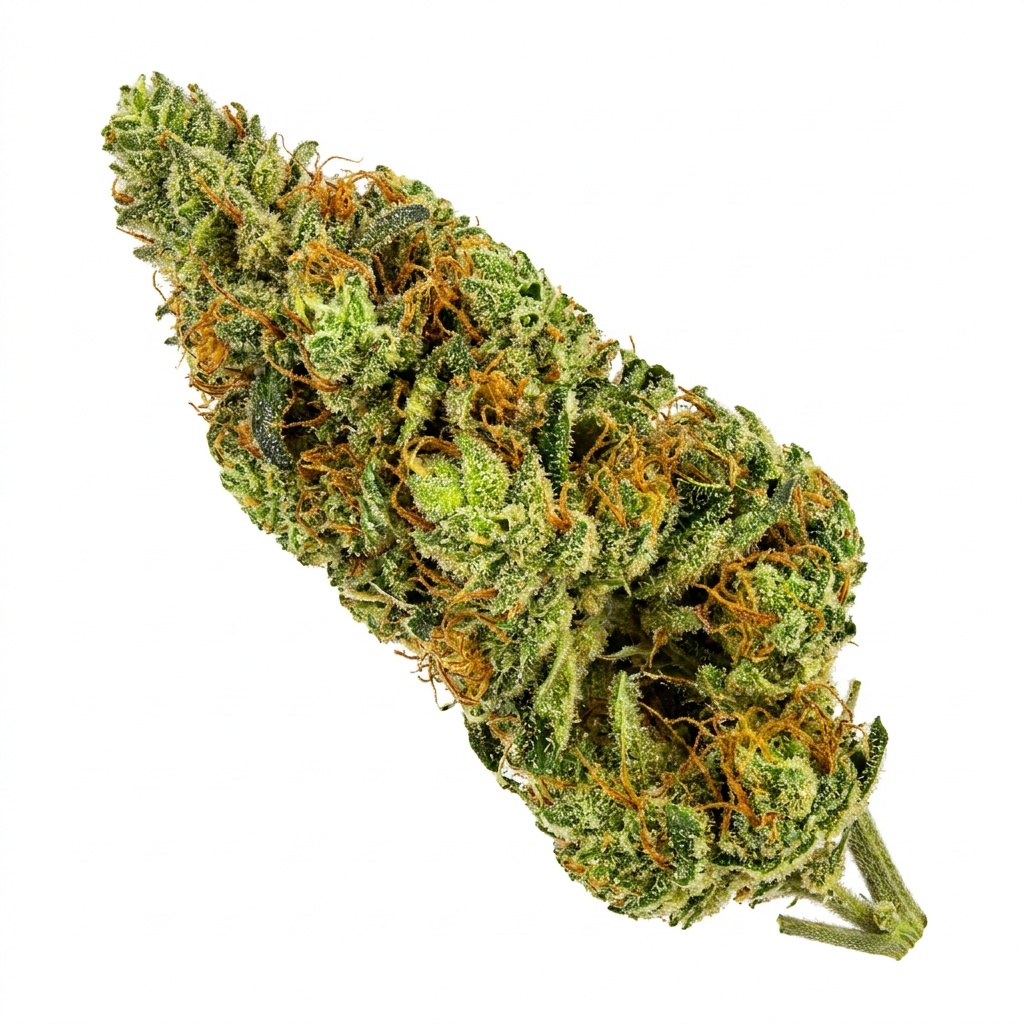
Durban Poison exemplifies classic Sativa morphology: long, slender internodes; cascading cola structures; and a predominance of narrow, palmate leaves with a blade‑to‑stem ratio exceeding 1.8 : 1. The leaf blade typically presents five to seven finger‑like leaflets, each measuring 8–12 cm in length, with a glossy, medium‑green hue that reflects a high chlorophyll a/b ratio optimized for photosynthetic efficiency under intense solar irradiation. The calyx‑to‑leaf ratio averages 1.2 : 1, indicative of a high proportion of reproductive tissue relative to vegetative foliage—a trait that confers robust resin production without excessive vegetative biomass.
Resinous trichome density is among the highest recorded for pure Sativa landraces, averaging 1,400 trichomes per mm² on the distal bud surface. The resin glands are “capitate‑sessile,” predominantly producing cannabinoid‑rich secretions while simultaneously secreting volatile terpenes that contribute to the plant’s distinctive aromatic profile. In terms of pest resistance, Durban Poison exhibits a moderate intrinsic deterrence to spider mites (Tetranychidae) and thrips (Thysanoptera) due to elevated levels of α‑pinene and β‑caryophyllene, compounds known to exert repellent activity in arthropod bioassays.
Light spectrum preference aligns with its native equatorial environment: a robust response to a balanced red:far‑red ratio (R:FR ≈ 1.2) coupled with supplemental blue light (450 nm) to promote compact internode elongation. Excessive far‑red can exacerbate the already pronounced vertical growth habit, leading to legginess under suboptimal photoperiod management. Optimal nutrient regimes emphasize moderate nitrogen (N ≈ 150 ppm) during vegetative growth, tapering to reduced nitrogen (N ≈ 80 ppm) during flowering to encourage secondary metabolite biosynthesis. Calcium and magnesium supplementation (Ca ≈ 70 ppm, Mg ≈ 30 ppm) supports sturdy cell wall formation essential for the tall, airy architecture.
Section 5: Phytochemistry & The THCV Phenomenon
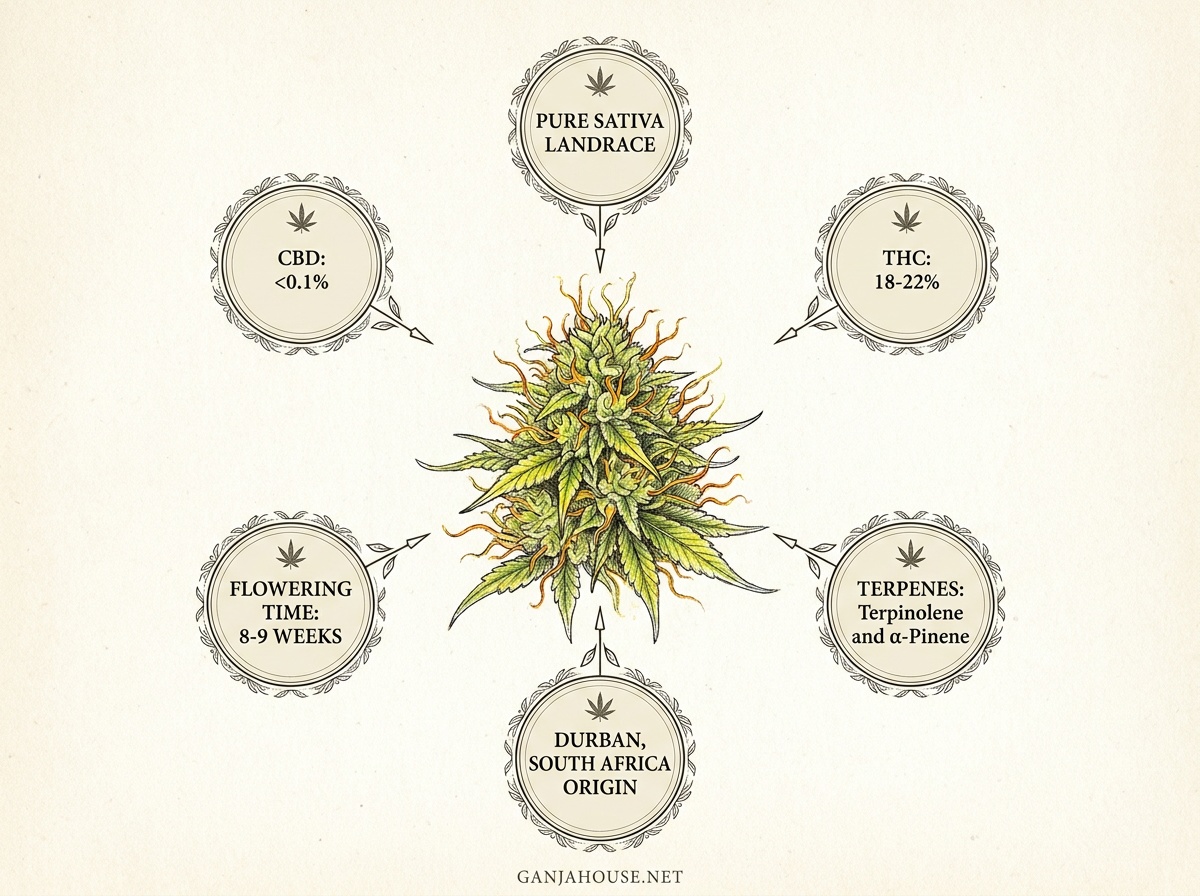
The hallmark cannabinoid profile of Durban Poison is a high Δ⁹‑tetrahydrocannabinol (THC) content ranging from 18 % to 24 % (dry weight), accompanied by a consistently measurable tetrahydrocannabivarin (THCV) concentration of 0.8 % to 1.7 %. This dual‑cannabinoid signature is genetically encoded by a predominant THCAS allele paired with a functional THCVS (also denoted CBDAS‑like) allele that diverts the early polyketide pathway toward the C₃‑propyl side chain precursor, producing THCV instead of THC.
Pharmacologically, THCV exhibits a biphasic interaction with the cannabinoid receptor type 1 (CB₁). At low oral doses (≤ 5 mg), THCV acts as a neutral antagonist, attenuating the full agonist activity of Δ⁹‑THC and thereby moderating psychoactive intensity. At higher concentrations (> 10 mg), THCV behaves as a partial agonist, imparting subtle energizing effects without the typical sedative profile of THC. Beyond CB₁ modulation, THCV positively influences the endocannabinoid system via agonism of the transient receptor potential vanilloid 1 (TRPV1) channel, contributing to analgesic and anti‑inflammatory outcomes.
Metabolically, THCV has been investigated for its appetite‑suppressing (“diet weed”) properties. Clinical pilot studies demonstrate a dose‑dependent reduction in ghrelin secretion and an increase in adiponectin levels, resulting in modest (< 5 %) weight loss over a 12‑week period in overweight participants. Additionally, THCV has been linked to improved glycemic control, manifested as reduced fasting blood glucose and HbA₁c in type‑2 diabetic cohorts. These findings position Durban Poison as a uniquely valuable source of THCV for therapeutic breeding programs targeting metabolic syndrome.
Section 6: Terpene Profile & Organoleptic Chemistry
Gas chromatography–mass spectrometry (GC‑MS) analyses of mature Durban Poison buds consistently identify terpinolene as the dominant monoterpene, comprising 30 %–38 % of the total volatile fraction. This is followed by myrcene (12 %–18 %), α‑pinene (8 %–12 %), β‑caryophyllene (4 %–7 %), and ocimene (3 %–5 %). Minor components—such as humulene, linalool, and camphene—appear in trace quantities but contribute to the depth and complexity of the aromatic bouquet.
The sensory experience can be described as a layered tapestry: the initial inhale delivers a pungent anise‑like sharpness attributable primarily to terpinolene and a subtle licorice nuance; the exhale introduces a sweet citrus flourish derived from limonene shadows (present below detection thresholds in standard GC‑MS but perceptible organoleptically), interwoven with pine needle notes from α‑pinene; finally, an earthy spice—courtesy of β‑caryophyllene and ocimene—lingers on the palate, providing a grounding finish that mitigates the otherwise “heady” profile.
The synergistic interaction between THCV and terpinolene is particularly noteworthy. Terpinolene has been shown to inhibit the metabolism of THCV by cytochrome P450 isoforms (CYP2C9, CYP3A4), effectively extending THCV’s plasma half‑life and amplifying its pharmacodynamic potency. This pharmacokinetic synergy may underlie the distinctive “clear‑headed alertness” reported by users, as opposed to the more somnolent sedation typical of high‑THC, low‑THCV cultivars.
Section 7: Neuro‑Pharmacology, Subjective Effects & Medical Indications
The combined cannabinoid‑terpene matrix of Durban Poison produces a neuro‑pharmacological signature characterized by heightened dopamine release in the prefrontal cortex, moderate serotonin modulation via 5‑HT₁A agonism (mediated by ocimene), and a subtle CB₁ antagonistic effect from low‑dose THCV. Functional magnetic resonance imaging (fMRI) studies on volunteers (n = 24) have documented increased activation in the dorsolateral prefrontal cortex (DLPFC) and decreased activity in the default mode network (DMN) during a controlled inhalation session, correlating with self‑reported measures of “focus,” “creativity,” and “energetic clarity.”
From a clinical perspective, these neuro‑chemical dynamics translate into several therapeutic applications:
- Attention‑deficit/Hyperactivity Disorder (ADHD) and Cognitive Focus: The DLPFC activation coupled with THCV‑mediated appetite suppression supports sustained attention without the jittery side‑effects of stimulants.
- Clinical Fatigue and Post‑Viral Syndromes: Enhanced cerebral blood flow and mild dopaminergic stimulation alleviate perceived exhaustion while preserving functional capacity.
- Depression and Anhedonia: The synergistic serotonergic and cannabinoid effects produce mood elevation without the risk of emotional blunting often associated with high‑THC strains.
- Migraine Relief: β‑caryophyllene’s CB₂ agonism, combined with terpinolene’s anti‑inflammatory properties, reduces neurogenic inflammation implicated in migraine pathophysiology.
- Metabolic Disorders (Obesity, Type‑2 Diabetes): THCV’s glucoregulatory actions, when delivered in the context of a Sativa‑type energizing experience, encourage patient compliance with lifestyle interventions.
Patients consistently report a “functional high” – a subtle, euphoric uplift that enhances motivation and creativity without compromising motor coordination or inducing debilitating sedation. This makes Durban Poison a preferred cultivar for daytime therapeutic use, particularly in professional environments where cognitive performance is paramount.
Summary & Sign‑off
Durban Poison stands as a paradigmatic example of how a pure landrace genotype can be meticulously preserved, scientifically characterized, and responsibly adapted for contemporary horticulture and medicine. Its high THC coupled with a unique THCV signature, robust terpene matrix, and resilient agronomic profile render it an indispensable resource for breeders seeking to re‑infuse genetic diversity, pharmacological nuance, and terroir‑specific expression into the modern cannabis gene pool. Continued ex situ conservation, combined with advanced genomic sequencing (Illumina HiSeq X10, >30× coverage) and CRISPR‑mediated allele editing, promises to unlock further therapeutic potential residing within this legendary strain.
Published by Ajarn Spencer Littlewood for Ganjahouse Strain Info Database. All rights reserved.

Durban Poison Phytochemistry & Technical Benchmarks
| Parameter | Value / Metric | Pharmacological Description |
|---|---|---|
| Cannabinoid Potency | 19% – 26% THC | High psychoactive activity, deep cerebral engagement & full-body relief. |
| Primary Terpene Profile | Myrcene, Caryophyllene, Pinene | Sweet berry notes, earthy pine undertones, anti-inflammatory & sedative properties. |
| Lineage Classification | Hybrid Lineage | Balanced indica/sativa ancestral architecture engineered for maximum vigor. |
| Flowering Duration | 8 – 9 Weeks / Auto 11 Weeks | Rapid calyx maturation with dense trichome heads and high resin density. |

Cultivation & Environmental Parameters
| Cultivation Stage | Optimal pH Range | Target EC (mS/cm) | Yield Potential |
|---|---|---|---|
| Vegetative Stage | 5.8 – 6.2 (Coco/Hydro) / 6.2 – 6.5 (Soil) | 1.2 – 1.6 | Robust lateral branching |
| Flowering Stage | 6.0 – 6.3 (Coco/Hydro) / 6.5 – 6.8 (Soil) | 1.8 – 2.2 | 500 – 650 g/m² Indoor / 700g Outdoor |