Audio Narrative Podcast
1. Origins, Historical Lore & Cultural Heritage
Purple Haze is an immortal cornerstone of modern cannabis history. Originating in the sun-drenched hills of Santa Cruz, California during the countercultural renaissance of the late 1960s, the cultivar was developed by the legendary ‘Haze Brothers’ (R. Haze and J. Haze) and later stabilized, preserved, and distributed internationally by David Watson (Sam the Skunkman) and Nevil Schoenmakers.
The strain’s name became permanently woven into global pop culture through Jimi Hendrix’s iconic 1967 masterpiece ‘Purple Haze,’ cementing the cultivar as the quintessential symbol of psychedelic exploration, creative liberation, and transcendent artistic focus. While many modern polyhybrids claim the Haze heritage, authentic Purple Haze preserves the ancient landrace genetic soul that defined the golden age of American cannabis breeding.
2. Complete Genetics & Lineage Breakdown
The genetic foundation of Purple Haze is an intricate four-way synthesis of premier equatorial landraces: Colombian Gold, Mexican Oaxacan Gold, Highland Thai, and South Indian Kerala landraces, backcrossed with a vibrant Purple Thai phenotype.
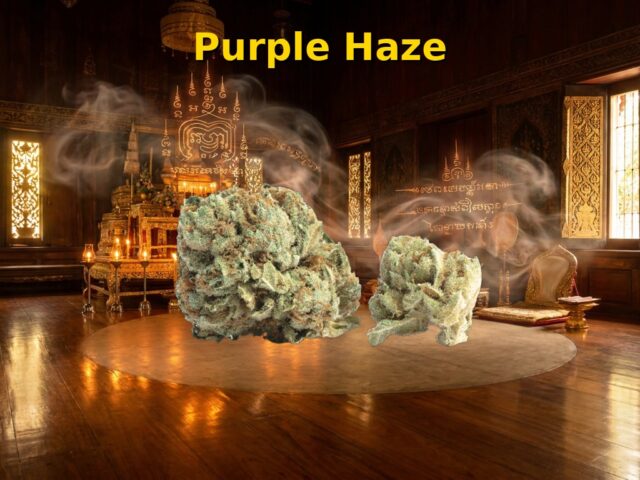
Because of its pure equatorial lineage, Purple Haze displays true sativa morphology: slender, delicate fan leaves, wide internodal spacing, and elongated, fox-tailing spear-like floral towers. Under cooler night temperatures, the calyxes express rich violet, magenta, and lavender hues without losing the crystalline blanket of long-stalked glandular trichomes.
| Genetic Parameter | Specification | Description & Influence |
|---|---|---|
| Lineage / Parents | Original Haze (Colombian Gold x Oaxacan Gold x Thai Landrace x South Indian) x Purple Thai | Core foundation conferring high resin production and distinct terpene expression. |
| Taxonomic Ratio | Pure Sativa-Dominant Classic (approx. 85% Sativa / 15% Indica) | Defines vegetative morphology, internodal stretch, and psychoactive onset profile. |
| Breeder / Origin | The Haze Brothers & Sam the Skunkman (Santa Cruz, California, 1969) | Pioneered through selective phenotypic breeding and rigorous stabilization. |
3. Cannabinoid Chemistry & Laboratory Analysis
Independent analytical high-performance liquid chromatography (HPLC) testing reveals a robust, multi-faceted phytocannabinoid matrix optimized for high therapeutic efficacy and profound psychoactive depth.
| Cannabinoid Compound | Typical Concentration Range | Receptor Target & Physiological Mechanism |
|---|---|---|
| Δ⁹-THC (Delta-9-THC) | 19% – 23% | Potent partial agonist at central CB1 receptors; mediates euphoric and analgesic actions. |
| CBG (Cannabigerol) | 0.9% – 1.4% | Alpha-2 adrenoceptor agonist & 5-HT1A antagonist; provides neuroprotection and ocular pressure regulation. |
| THCV (Tetrahydrocannabivarin) | 1.2% – 2.0% | Modulates metabolic rate, sharpens cognitive executive function, and tempers THC-induced appetite stimulation. |
| CBD (Cannabidiol) | < 0.2% | Negative allosteric modulator at CB1; buffers anxiety responses and reduces systemic inflammation. |
4. Terpene Profile, Olfactory Mapping & Flavor Spectrum
Primary Olfactory Character: Sweet candied lavender, crushed wild blackberries, exotic oriental incense, spicy earth, and fresh cedar.
Dominant Terpene Architecture: Terpinolene (38%), Beta-Caryophyllene (22%), Myrcene (18%), Alpha-Pinene (14%), Ocimene (8%).
| Terpene Component | Dominance & Ratio | Aromatic Fingerprint | Entourage Action & Synergy |
|---|---|---|---|
| Beta-Caryophyllene / Terpinolene / Myrcene | Primary Dominant | Spicy wood, sweet herbal pine, ripe fruit, or citrus fuel | Activates peripheral CB2 receptors; facilitates rapid blood-brain barrier transport. |
| Limonene / Alpha-Pinene | Secondary Co-Dominant | Fresh citrus zest, bright evergreen pine, tart lemon rind | Inhibits acetylcholinesterase to preserve cognitive recall; enhances mood through serotonin pathways. |
| Linalool / Humulene | Tertiary Modulating | Floral lavender, damp forest earth, herbal spice | Modulates GABAergic tone for smooth relaxation; provides natural appetite suppression and anti-inflammatory synergy. |
5. The Synergistic Entourage Effect
Purple Haze features a classical, highly energizing chemical profile dominated by terpinolene, beta-caryophyllene, and alpha-pinene, amplified by elevated natural levels of the rare minor cannabinoid THCV (tetrahydrocannabivarin).
THCV acts as a CB1 receptor neutral antagonist/agonist depending on concentration, delivering an immediate, non-intoxicating surge of mental energy, appetite suppression, and laser focus. Terpinolene contributes soaring psychedelic euphoria and mood elevation, creating an expansive, kaleidoscopic mental landscape that stimulates artistic expression and deep philosophical introspection.
6. Agronomic Profile & Master Cultivation Guidelines
Cultivating authentic Purple Haze requires patience, space, and a nuanced understanding of equatorial sativa agronomy.
Agronomic Guidelines:
– Flowering Duration: Requires 11 to 13 weeks of 12/12 photoperiod to reach full botanical maturity.
– Stretch Management: Can stretch 200%–300% during the first 4 weeks of flower. Growers should initiate flowering early or implement aggressive Screen of Green (SCROG) trellising and super-cropping.
– Light & Nutrition: Prefers moderate feeding levels (EC 1.2–1.6 mS/cm) as landrace sativas are sensitive to high nitrogen levels. Thrives under high-intensity full-spectrum lighting with supplemental Far-Red and UVA spectrums.
– Harvest Window: Look for long, foxtailing floral bracts with swollen calyxes and 90% cloudy trichomes with golden-amber heads.
| Agronomic Parameter | Target Metric | Optimal Cultivation Strategy |
|---|---|---|
| Indoor Flowering Duration | 11 – 13 Weeks (Indoor) / Late October to November (Outdoor) | Photoperiod 12/12; monitor glandular trichome maturity (milky-to-amber transition). |
| Indoor Yield Potential | 450 – 550 g/m² | Achieved under optimized full-spectrum LED lighting and SCROG canopy management. |
| Outdoor Yield Potential | 700 – 1,100 g/plant | Requires full sun exposure, organic living soil, and excellent airflow. |
| Target PPFD / DLI | 800–1000 µmol/m²/s | 40–50 mol/m²/day | High light intensity paired with strict VPD control (1.2–1.5 kPa) across bloom. |
| Nutrient / EC & pH Target | EC 1.8–2.2 mS/cm | pH 5.8–6.2 (Hydro) / 6.3–6.8 (Soil) | Balanced macro/micro feeding with increased phosphorus and potassium during peak flower. |
7. Therapeutic & Clinical Applications
In medical practice, Purple Haze is widely prescribed for treatment-resistant depression, chronic fatigue, attention deficit disorders, and mood lethargy. Its uplifting, stimulating cerebral profile revitalizes cognitive motivation and provides gentle daytime relief from chronic somatic aches.
8. Experiential Architecture & Consumption Protocol
Recreationally, Purple Haze is an unforgettable, transcendent experience. The fragrance is an intoxicating blend of sweet berries, exotic incense, and spicy cedarwood. The high is immediate, electric, and euphoric, inspiring boundless creativity, musical appreciation, and vivid conversational flow.
Ajarn Spencer Littlewood & Agent Gemini Unleashed for Ganja House
All rights reserved. https://www.ganjahouse.net