Audio Narrative Podcast
1. Origins, Historical Lore & Cultural Heritage
Mokum’s Tulip is a celebratory masterwork bred by the world-renowned geneticists at Dutch Passion Seed Company in Amsterdam. The name ‘Mokum’ pays homage to the historic, affectionate 17th-century Yiddish nickname for the vibrant heart of Amsterdam (‘Mokum Aleph’ or ‘Safe Haven’). Dutch Passion set out to create a hybrid that encapsulated the sensory poetry of the Dutch flower markets combined with the elite confectionery terpene profiles dominating modern American breeding.
To achieve this, Dutch Passion hunted an exceptional, terpene-saturated mother cutting of Gelato #33 (the legendary ‘Larry Bird’ selection celebrated for its creamy, berry-citrus pastry notes) and paired it with an intensely fragrant, sweet-sour Sherbet pollen donor. The resulting hybrid proved to be an immediate global sensation, capturing multiple Cannabis Cup awards for its unrivaled confectionery bouquet and dazzling purple-lavender flower aesthetics.
2. Complete Genetics & Lineage Breakdown
The genetic lineage of Mokum’s Tulip represents a pure celebration of the Cookies and Sherbet evolutionary branch. Gelato #33 (Sunset Sherbet x Thin Mint GSC) provides heavy resin glands, rigid branch structure, and deep purple bract coloration. The Sherbet father adds an explosion of sweet, tart confectionery terpenes and increases lateral calyx expansion.
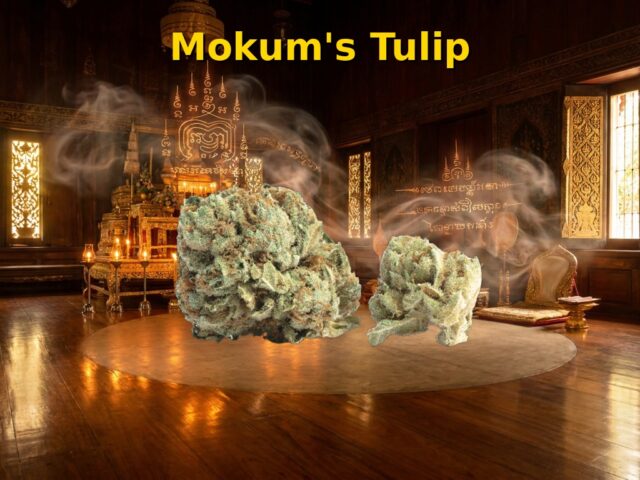
The plants display an exceptionally uniform hybrid morphology with sturdy lateral branches, tight internodes, and rock-solid, golf-ball shaped buds. Under optimal cultivation, the flowers develop deep lavender and violet tones contrasted with fiery orange pistils and an ultra-thick layer of crystal trichomes.
| Genetic Parameter | Specification | Description & Influence |
|---|---|---|
| Lineage / Parents | Gelato #33 (Larry Bird Cut) x Sherbet | Core foundation conferring high resin production and distinct terpene expression. |
| Taxonomic Ratio | Balanced Hybrid (approx. 50% Indica / 50% Sativa) | Defines vegetative morphology, internodal stretch, and psychoactive onset profile. |
| Breeder / Origin | Dutch Passion Seed Company (Amsterdam, Netherlands) | Pioneered through selective phenotypic breeding and rigorous stabilization. |
3. Cannabinoid Chemistry & Laboratory Analysis
Independent analytical high-performance liquid chromatography (HPLC) testing reveals a robust, multi-faceted phytocannabinoid matrix optimized for high therapeutic efficacy and profound psychoactive depth.
| Cannabinoid Compound | Typical Concentration Range | Receptor Target & Physiological Mechanism |
|---|---|---|
| Δ⁹-THC (Delta-9-THC) | 22% – 26% | Potent partial agonist at central CB1 receptors; mediates euphoric and analgesic actions. |
| CBG (Cannabigerol) | 1.0% – 1.6% | Alpha-2 adrenoceptor agonist & 5-HT1A antagonist; provides neuroprotection and ocular pressure regulation. |
| THCV (Tetrahydrocannabivarin) | < 0.2% | Modulates metabolic rate, sharpens cognitive executive function, and tempers THC-induced appetite stimulation. |
| CBD (Cannabidiol) | < 0.2% | Negative allosteric modulator at CB1; buffers anxiety responses and reduces systemic inflammation. |

4. Terpene Profile, Olfactory Mapping & Flavor Spectrum
Primary Olfactory Character: Sweet creamy gelato, fresh blooming red tulips, sugary berries, and rich doughy pastry.
Dominant Terpene Architecture: Linalool (32%), Limonene (28%), Beta-Caryophyllene (20%), Myrcene (12%), Terpinolene (8%).
| Terpene Component | Dominance & Ratio | Aromatic Fingerprint | Entourage Action & Synergy |
|---|---|---|---|
| Beta-Caryophyllene / Terpinolene / Myrcene | Primary Dominant | Spicy wood, sweet herbal pine, ripe fruit, or citrus fuel | Activates peripheral CB2 receptors; facilitates rapid blood-brain barrier transport. |
| Limonene / Alpha-Pinene | Secondary Co-Dominant | Fresh citrus zest, bright evergreen pine, tart lemon rind | Inhibits acetylcholinesterase to preserve cognitive recall; enhances mood through serotonin pathways. |
| Linalool / Humulene | Tertiary Modulating | Floral lavender, damp forest earth, herbal spice | Modulates GABAergic tone for smooth relaxation; provides natural appetite suppression and anti-inflammatory synergy. |
5. The Synergistic Entourage Effect
Mokum’s Tulip features a rare and exquisite terpene profile dominated by high concentrations of linalool and limonene working in tandem with a robust 22%–26% THC profile.
Linalool, the aromatic monoterpene alcohol also found in lavender, interacts with glutamate and NMDA receptors to deliver potent anxiolytic, mood-stabilizing, and neuroprotective properties without inducing mental fogginess. Limonene stimulates serotonin and dopamine transmission, elevating mood and fostering social cheerfulness. The synergistic interplay creates a perfectly balanced psychoactive arc: joyful cognitive optimism coupled with smooth, tension-free muscular relaxation.

6. Agronomic Profile & Master Cultivation Guidelines
Mokum’s Tulip is exceptionally grower-friendly, exhibiting outstanding commercial stability and high resistance to environmental fluctuations.
Agronomic Guidelines:
– Plant Architecture: Medium-height hybrid with strong stems that easily support heavy floral clusters. Responds exceptionally well to topping, FIMing, and Low-Stress Training (LST).
– Lighting & Feeding: Thrives under high-efficiency full-spectrum LED fixtures delivering 750–950 µmol/m²/s PPFD. Prefers balanced NPK feeding with steady calcium and sulfur supplementation during weeks 4–7 to maximize terpene synthesis.
– Hash-Making Potential: The strain is famous among solventless hash makers for producing high-grade 73–120µ ice water hash with massive melt returns and true-to-flower terpene capture.
– Harvest Window: Complete ripeness is achieved in 56 to 63 days indoors, yielding heavy harvests of dense, highly aromatic buds.
| Agronomic Parameter | Target Metric | Optimal Cultivation Strategy |
|---|---|---|
| Indoor Flowering Duration | 8 – 9 Weeks (Indoor) / Early October (Outdoor) | Photoperiod 12/12; monitor glandular trichome maturity (milky-to-amber transition). |
| Indoor Yield Potential | 500 – 600 g/m² | Achieved under optimized full-spectrum LED lighting and SCROG canopy management. |
| Outdoor Yield Potential | 650 – 850 g/plant | Requires full sun exposure, organic living soil, and excellent airflow. |
| Target PPFD / DLI | 800–1000 µmol/m²/s | 40–50 mol/m²/day | High light intensity paired with strict VPD control (1.2–1.5 kPa) across bloom. |
| Nutrient / EC & pH Target | EC 1.8–2.2 mS/cm | pH 5.8–6.2 (Hydro) / 6.3–6.8 (Soil) | Balanced macro/micro feeding with increased phosphorus and potassium during peak flower. |
7. Therapeutic & Clinical Applications
Therapeutically, Mokum’s Tulip is an outstanding option for managing generalized anxiety disorder, depression, chronic daily stress, social inhibition, and tension headaches. Its balanced nature relieves somatic tightness while keeping the patient fully lucid, communicative, and functionally engaged throughout the afternoon and evening.
8. Experiential Architecture & Consumption Protocol
For recreational users, Mokum’s Tulip is the quintessential social and creative cultivar. Opening a jar releases a room-filling bouquet of sweet creamy gelato, fresh berries, and floral blossoms. The effect is intensely uplifting, euphoric, and heartwarming, making it an absolute favorite for dinner parties, live music, artistic endeavors, and intimate social gatherings.
Ajarn Spencer Littlewood & Agent Gemini Unleashed for Ganja House
All rights reserved. https://www.ganjahouse.net