
Exploring Potential Uses of Cannabis: Using Hemp Cannabinoids as a Natural Alternative to Chemical Pesticides
Recent research from Cornell University suggests a promising avenue for the future of pest control hemp cannabinoids. The study, conducted by scientists at the School of Integrative Plant Science at Cornell AgriTech’s College of Agriculture and Life Sciences (CALS), delved into the potential applications of cannabinoids as natural pesticides. The researchers discovered that hemp plants with a higher concentration of cannabinoids in their leaves exhibited less damage from chewing insects compared to those with lower cannabinoid levels. This finding opens up possibilities for the development of new, natural insecticides, primarily targeted for use on non-edible plants.
However, the application of these pesticides on food crops remains uncertain due to the pharmacological effects of cannabinoids, such as CBDA, THCA, and CBGA. These compounds can be converted to CBD, THC, and CBG, respectively, through a process known as decarboxylation, which involves the addition of heat.
Larry Smart, a plant breeder and professor at CALS, noted that while the intoxicating and medicinal effects of cannabinoids have been studied for decades, little research has been conducted to understand why cannabis plants evolved to produce over 100 distinct substances.
“It has been speculated that they are defensive compounds, primarily accumulating in female flowers to protect seeds, a common concept in plants,” said Smart, the senior author of the study.
The research was part of Cornell’s Hemp Breeding Program, initiated in 2017. The program evaluates various commercially available hemp cultivars to provide recommendations to farmers based on local soil and climate conditions.
Varieties of hemp from a breeding program in Ukraine, lacking cannabinoid production, were found to be highly susceptible to damage from Japanese beetles. In contrast, hemp varietals producing cannabinoids demonstrated reduced vulnerability to these insects.
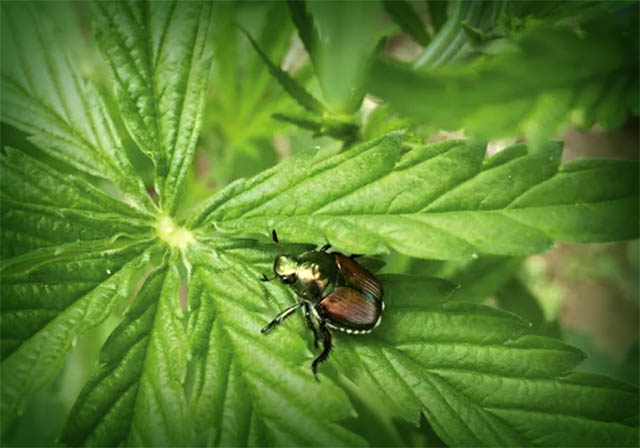
Japanese Beetle Eating Cannabis.
“In the absence of cannabinoids, we saw heavy insect damage, and in the presence of cannabinoids, we saw much less damage,” explained Smart.
Isolating CBDA and CBGA for controlled insect feeding studies, the researchers observed that insect larvae experienced stunted growth and lower survival rates with increasing cannabinoid concentrations. Following the recent legalization of hemp for commercial cultivation in the United States, farmers are seeking comprehensive advice on integrated pest management (IPM). A fresh article in the freely accessible Journal of Integrated Pest Management provides an up-to-date overview of ongoing research related to insect and arthropod pests affecting hemp, highlighting areas that require further investigation.
George Stack, a postdoctoral researcher in Smart’s lab, emphasized that the study provides insight into how cannabinoids function in natural systems. He sees the potential to develop THC-compliant hemp cultivars with natural defenses against herbivores.
The researchers plan to investigate the impact of cannabinoids on sap-sucking insects like aphids. However, the ongoing federal illegality of marijuana poses challenges to this research. While the prospect of cannabinoids as pesticides sparks excitement for future research, regulatory barriers are anticipated due to the pharmacological activity of these compounds. Further studies are essential to determine the pests against which cannabinoids will be most effective. The study, titled “Cannabinoids Function in Defense Against Chewing Herbivores in Cannabis Sativa L.,” was published in October in the peer-reviewed journal Horticulture Research.
Cannabis sativa as a Promising Eco-Friendly Pesticide: Potential Risks and Benefits
Despite the undeniable benefits synthetic pesticides have offered in pest and disease control, their usage comes at a significant cost to the environment and living organisms, prompting a growing interest in eco-friendly alternatives. This article delves into the available ethnobotanical evidence and conducts a systematic review of experimental studies to analyze the potential of Cannabis sativa as a pesticide.
Methods: The study explores ethnobotanical evidence and reviews experimental studies to assess the viability of C. sativa as a pesticide, considering its potential benefits and drawbacks. The findings suggest that both ethnobotanical knowledge and experimental studies support the efficacy of C. sativa as a pesticide, showcasing remarkable toxicity against various pest organisms. The systematic review of experimental studies (n=30) reveals a degree of heterogeneity but draws certain conclusions to guide further research. Notably, promising pesticide properties were observed, particularly against Arachnida and Insecta. The diverse compounds within C. sativa contribute to its efficacy, potentially through synergistic effects. Standardizing the phytochemical profile, exploring appropriate extraction methods, and considering different parts of the plant for essential oil production are crucial for obtaining reproducible results.
Opinion: As new findings emerge, the promising potential of C. sativa as a pesticide will become clearer. This review serves as a valuable tool for understanding the potential benefits and risks associated with using C. sativa as an eco-friendly alternative. It underscores the importance of responsible exploration and application of such alternatives, particularly in the context of the environmental challenges posed by conventional pesticides.
Postscript: In reflecting on the potential of Cannabis sativa as a pesticide, it is essential to recognize the broader implications of pesticide use on the environment. This study sheds light on the promising aspects of C. sativa as a natural pesticide, emphasizing the need for responsible and informed exploration of alternatives. The article raises questions about the potential risks and benefits associated with cannabinoids and prompts consideration of the environmental impact of conventional pesticides, drawing parallels to the color-coated pesticide balls used in certain regions, which have contributed to a significant decline in global insect populations. As we navigate these discussions, it becomes imperative to strike a balance between effective pest control and the preservation of our ecosystems.
Further Study and research Sources;
https://entomologytoday.org/tag/cannabis-aphid/
“IPM in Hemp: Managing Pests in a “New” Crop” PMID: 34612729 PMCID: PMC9418361 DOI: 10.1089/can.2021.0095 – https://pubmed.ncbi.nlm.nih.gov/34612729/
Determination of pesticides residue in cannabis; https://pharmacy.mahidol.ac.th/journal/_files/2021-48-4_6.pdf